
Bird Friendly Window Film Toronto & GTA — Bird-Safe Glazing | ImpactGuard
The glass looks like sky. That is the whole problem.
Bird collision deterrent window film for retail, commercial and institutional glass across Toronto and the GTA. First-surface visual markers at 50 mm spacing, specified to CSA A460:19 and the Toronto Green Standard, installed on the glass you already have — with the documentation your planner, landlord or insurer will ask for.
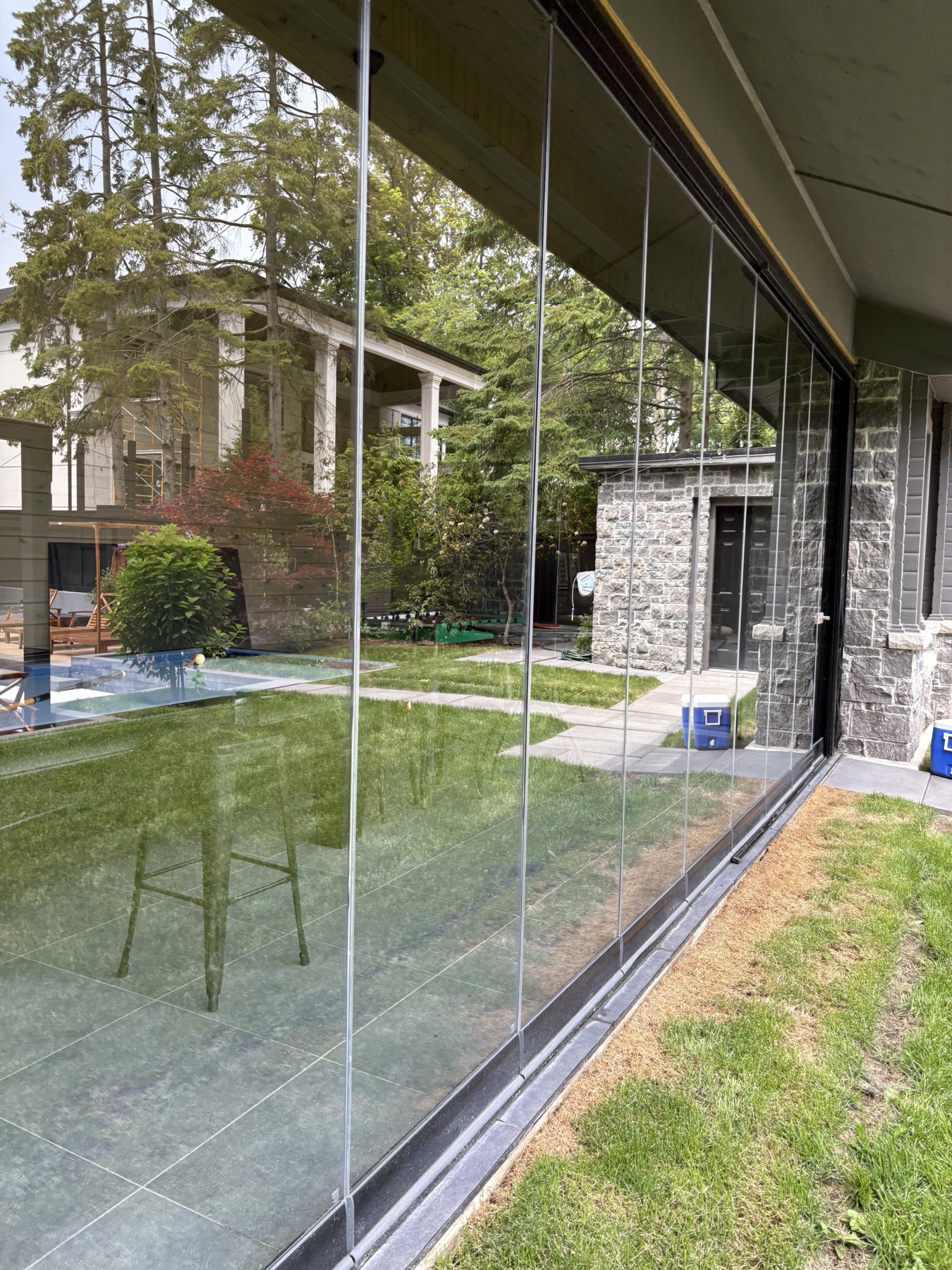
A bird cannot see glass. It sees what the glass is showing it.
Reflective glazing hands a bird a picture of the sky it was already flying toward, or of the tree it was aiming for. Clear glass on a corner, a vestibule, or a covered link shows it a clean flight path straight through the building. In both cases the bird is not making a mistake. It is reading the information the façade is giving it, and flying into a pane at full speed.
That is why nothing about the glass itself fixes this — not low-e, not tint, not thickness. The only thing that works is putting a pattern on the outside face that the bird can resolve as a solid object before it commits.
Birds killed each year in Canada by collisions with buildings — the Environment Canada estimate. Second only to cats among direct human causes.
The height above grade where the standard concentrates treatment — roughly the mature tree canopy, and where the overwhelming majority of strikes happen.
Of exterior glazing within that first 16 m that the standard asks to be treated with visual markers.
Maximum spacing between markers, horizontally and vertically. Wider than that and birds fly the gap.
The 25 million figure is the midpoint of a published 16–42 million range. Roughly 90% of those collisions happen at houses and about 9% at low-rise buildings, with under 1% at towers — the volume is spread across every building with glass in it, not concentrated downtown. What is concentrated at commercial buildings is the visibility: a reflective podium beside a planted forecourt produces a repeatable pile of birds on the sidewalk, in front of staff, tenants and the public.
A pattern on the outside of the glass. Nothing else changes.
Bird-safe film is a marked polyester laminate applied to the first surface — the exterior face — of your existing glazing. It does not tint the glass, does not need the window replaced, and on the dot patterns transmits most of the visible light straight through. From inside, tenants look past it. From outside, at flight speed, it is a wall.

Dot grids
A 50 mm grid of small dots on the outside face of the glass. The lowest threat-factor option in tunnel testing and the pattern that reads most clearly as an obstacle to a bird in flight — while staying close to invisible from six feet away inside.
Lines and stripes
Vertical or horizontal linear markers at the same 50 mm spacing. Often the better fit on storefront glass and curtain wall, where a line pattern disappears into the mullion rhythm of the façade.
Frost and etch
Acid-etch-look frosted bands and custom-cut graphics that satisfy the spacing rule while doing a second job — wayfinding, privacy at a boardroom, or brand pattern across an entrance.
Layered systems
Bird markers on the exterior surface with solar-control or UL-972 security film on the interior. One glass, three jobs, no conflict — the two films never share a surface.
Threat Factor
Bird-safe patterns are not rated on how they look. The American Bird Conservancy flies wild birds down a test tunnel toward two panes and scores the percentage that choose the treated one. That percentage is the material's Threat Factor — lower is better. ABC will not recommend anything above 30, and a score of 30 implies collisions cut by at least half.
We specify tunnel-tested patterns and put the score in your quote. If a supplier cannot give you a Threat Factor for the exact pattern at the exact spacing, the pattern has not been tested and you are buying decoration.
Who actually requires this in the GTA.
Toronto has asked for bird-friendly glazing on new development since 2007 and other GTA municipalities have followed with their own green development standards. The provincial picture for new applications has been moving — but none of those standards ever governed a building that is already standing, and the pressure on existing commercial glass comes from somewhere else entirely.
New development, Tier 1
TGS measure EC 5.1 asks for visual markers on at least 85% of exterior glazing within the first 16 m above grade, on the first surface, minimum 5 mm wide, spaced no more than 50 × 50 mm. Bill 23 and then Bill 98 have narrowed what the City can require through site plan approval, so confirm the current position with your planner — the specification itself has not changed.
The national standard
Canada’s bird-friendly building design standard. Markers no more than 50 mm apart in both directions, minimum 4 mm across (or 2 × 9 mm if linear), applied to the exterior surface. It covers existing buildings as well as new ones, and it is what Mississauga and other GTA municipalities have aligned their own standards to.
Existing buildings, and the reason to act
In Podolsky v. Cadillac Fairview (2013) an Ontario court held that light reflected off a building can be a contaminant under the Environmental Protection Act where it kills birds. The owners were acquitted — they had already begun treating the glass, and due diligence carried them. The finding stands, and the acquittal is the instruction: treat the glass.
The fuller version — which GTA municipalities require what, what Bill 23 and Bill 98 changed, and what a landlord or lease can oblige you to do regardless — is in is bird-friendly glass required in Toronto? None of this is legal advice; it is what we build the specification around.
Getting birds on your sidewalk?
We survey the elevation, find the panes doing the damage, and quote the treatment in writing.
The panes that do the killing are predictable.
It is almost never the whole building. It is the reflective podium facing a planted forecourt, the glass corner at the entrance, the vestibule you can see straight through, the railing on a second-floor terrace, the link between two buildings with sky on both sides. Plaza retail, office podiums, campuses, hospitals, schools, dealerships and grocery anchors across the GTA all fail in the same handful of places.
We treat those first. Most commercial jobs are a targeted elevation, not a whole-envelope programme — which is what makes them affordable and why the complaint usually stops after one visit.


Outside surface. No glass replaced. No trading day lost.
Bird markers are the one film that has to go on the outside. Applied to the interior surface the pattern sits behind the reflection, and the bird never sees it — which is why every standard specifies first surface, and why exterior-grade film and a proper surface prep matter more here than anywhere else on the building.
Survey
We walk the elevation, identify the glass that is actually killing birds — reflective spans, glass corners, railings, anything with vegetation or sky behind it — and measure the first 16 m above grade. You get a written fixed quote and a marked-up elevation.
Apply
Markers go on the first surface, the outside face of the glass. That is where every standard requires them and it is the only surface where a bird sees the pattern instead of a reflection. Ground-level and low-rise glass is done off ladders and lifts, out of hours where the site needs it.
Document
You get the pattern spec, the tunnel-test threat factor, the treated-area calculation against the 85% / 16 m rule, and photographs of the finished elevation — the package a planner, a landlord, or an ESG reviewer asks for.
Bird markers layer with the rest of the glass package. Solar-control and privacy film from the SolarLine range and UL-972 commercial security film both go on the interior surface, so one pane can carry heat rejection, forced-entry protection and bird deterrence at the same time.
Markers, sightlines, seasons, and what it will not do.
Including the two answers most bird-film pages avoid: it has to go on the outside of the glass, and nothing on the market takes collisions to zero.
01Does bird-friendly window film actually stop birds hitting the glass?
Does bird-friendly window film actually stop birds hitting the glass?
It reduces strikes substantially rather than eliminating them. Patterns are scored by the American Bird Conservancy in a flight tunnel, where wild birds choose between a treated and an untreated pane; the resulting Threat Factor is the percentage that flew at the treated one, so lower is better. ABC will not recommend anything scoring above 30, and a score of 30 implies collisions cut by at least half. The best-performing dot patterns score in the single digits. Nobody honest will promise you zero.
02Why does the film have to go on the outside of the glass?
Why does the film have to go on the outside of the glass?
Because a bird is looking at a reflection. Markers applied to the interior surface sit behind that reflection and are effectively invisible to an approaching bird, which is why the Toronto Green Standard and CSA A460:19 both specify the first surface, the exterior face of the glass. It is the one window film that has to be installed outside, and it is why exterior-grade material and proper surface preparation matter more here than on an interior install.
03How far apart do the markers have to be?
How far apart do the markers have to be?
No more than 50 mm in both directions, horizontally and vertically. CSA A460:19 also sets a minimum element size of about 4 mm across, or 2 mm by 9 mm for linear markers, and the Toronto Green Standard asks for a minimum 5 mm width. Wider spacing is where most cheap or decorative treatments fail: birds will attempt to fly through a gap they judge passable, so a handful of decals on a large pane does very little.
04Will it change how the storefront looks from inside?
Will it change how the storefront looks from inside?
Far less than people expect. The markers are small and the spacing is regular, so at normal viewing distance inside a room the pattern falls away and you read the view, not the dots. Dot patterns transmit most of the visible light through the glass. Standing with your face at the window you will see it, which is the point — that is roughly the resolution a bird gets at flight speed.
05Is bird-friendly glazing required for commercial buildings in the GTA?
Is bird-friendly glazing required for commercial buildings in the GTA?
For new development it has been required through municipal green development standards — Toronto since 2007, with Mississauga, Vaughan, Markham and others following, most of them aligned to CSA A460:19. Provincial legislation has narrowed how much municipalities can enforce through site plan approval, so anyone with a live application should confirm the current position with their planner. For a building that already exists, no by-law compels it; what drives retrofits is liability, lease and landlord obligations, ESG and LEED reporting, and the fact that a visible pile of dead birds on the sidewalk is its own problem.
06Can bird film go on the same windows as solar or security film?
Can bird film go on the same windows as solar or security film?
Yes, because they occupy different surfaces. Bird markers go on the exterior face; solar-control, privacy and UL-972 security films go on the interior face. One pane can carry heat rejection, forced-entry protection and bird deterrence at once, and specifying them together is cheaper than doing it in three visits.
07How long does exterior bird film last?
How long does exterior bird film last?
Exterior-mounted film does the harder job — full sun, freeze-thaw, and everything the weather does to a Toronto façade — so bird markers are specified as exterior-grade material rather than an interior film moved outside. Premium marker patterns are manufactured for that exposure and for repeated cleaning. We confirm the manufacturer’s warranty term for the exact pattern in your written quote, alongside its tunnel-tested Threat Factor.
08When is the worst time of year for bird strikes?
When is the worst time of year for bird strikes?
Spring and fall migration, roughly April to May and again from late August through October. That is when volume moves through the GTA and when a problem façade produces birds day after day. Treatment can be installed year-round in suitable weather, but if you are planning around a season, getting it done before the fall migration is the version that pays off soonest.
09Do I have to treat the whole building?
Do I have to treat the whole building?
Rarely. Strikes concentrate in a predictable set of places: reflective glass facing trees or planting, glass corners, see-through vestibules and links, terrace railings, and glazing in the first 16 metres above grade where most collisions happen. On most commercial buildings the fix is a defined set of elevations rather than the whole envelope, which is what keeps it affordable. The survey exists to identify exactly which panes those are.
- Free in-person assessment
- Typically booked within 48 hours
- No pressure, no subscriptions
Stop the strikes on your building.
Free façade survey across Toronto and the GTA. We identify the glass causing collisions, specify a tunnel-tested pattern, and quote it in writing.