
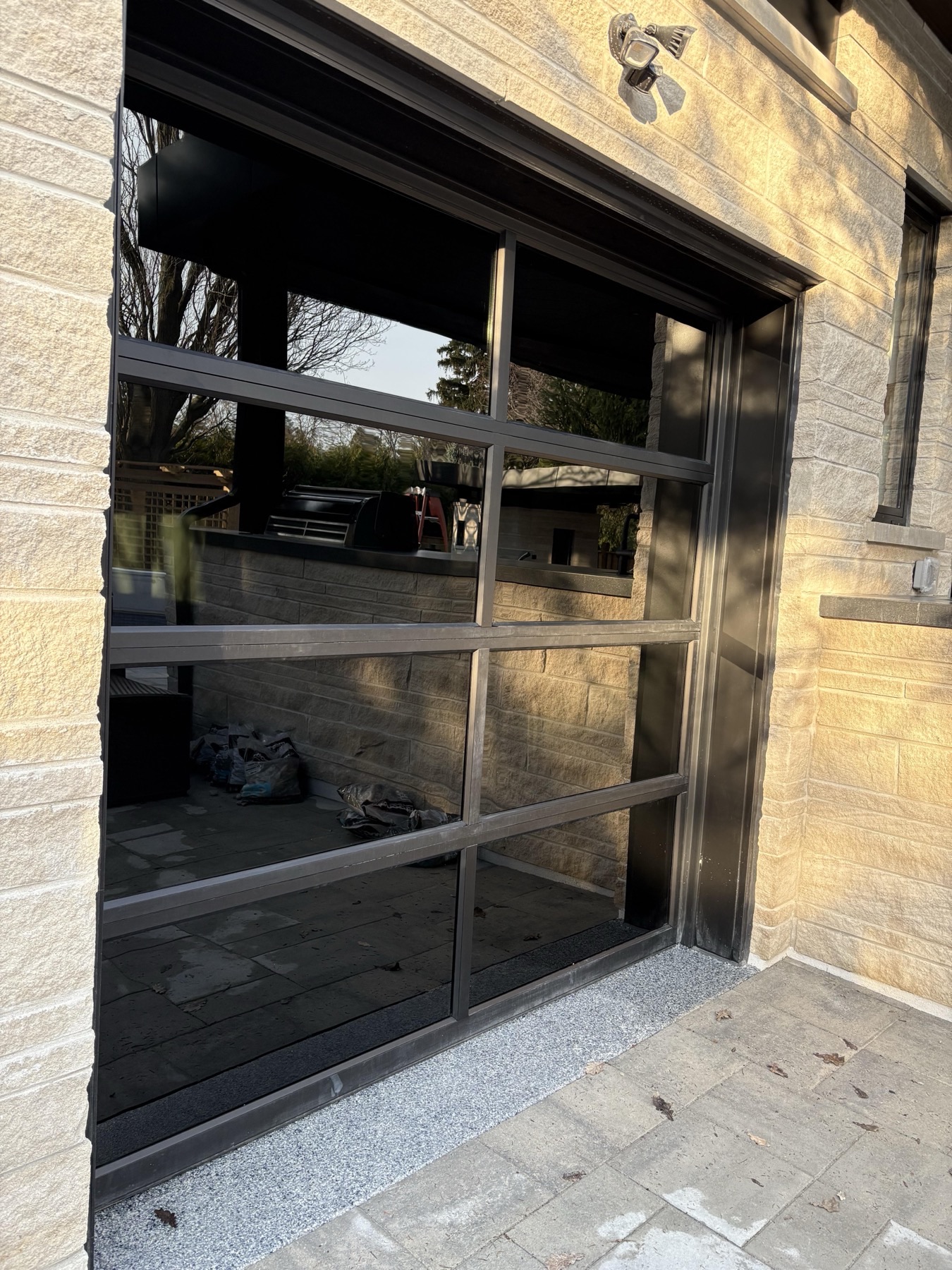
The call almost always arrives in spring, and it almost always opens the same way: birds are turning up at the base of the same two or three glass panels, in the same weeks every year, and somebody wants one thing settled before they spend anything. Is this something we are legally required to fix, or something we are choosing to fix?
It is a harder question than it was three years ago, and almost every page you will find on it is out of date. The short version: for a building that already exists, no by-law in the GTA compels you to treat the glass — and one Ontario court decision, plus your lease, your insurer and your tenants, may well amount to the same thing in practice.
What is actually required, as of September 2026
Three separate situations, and people conflate them constantly:
- An existing building. No municipal requirement, and never was one. Green development standards attach to development applications. If your building is standing and you are not renovating into an approval, no planner is going to ask you about bird glazing.
- A new development application. This is the part that changed. Toronto and roughly a dozen other Ontario municipalities used site plan control to require bird-friendly glazing; a run of provincial bills from 2022 to 2026 removed most of that authority. Confirm the current position with the planner on your file, because it now depends on your submission date.
- Either of the above, after birds start dying. This is governed by the Ontario Environmental Protection Act, not by a planning by-law, and nothing the province has done since 2022 has touched it.
What the standards actually ask for
Whatever their enforceability, the technical requirements have been stable and consistent for years, and they are what a competent installer builds a quote around. There are two documents that matter in Ontario.
Toronto Green Standard, measure EC 5.1
Toronto’s Bird Collision Deterrence measure asks that at least 85% of exterior glazing within the first 16 metres above grade be treated with visual markers. The markers go on the first surface — the outside face of the glass — at a minimum 5 mm width and a maximum spacing of 50 mm by 50 mm. It applies to more than the obvious façade glass: balcony railings, clear glass corners, parallel glass and glazing around interior courtyards are all named.1
The 16-metre line is not arbitrary. It approximates the height of a mature tree canopy, and it is the band where the overwhelming majority of fatal collisions occur. Above it, birds are generally flying rather than foraging.
CSA A460:19, the national standard
CSA A460 is Canada’s bird-friendly building design standard, and unlike a green development standard it explicitly covers existing buildings as well as new construction. Its marker rule is the one the industry shorthands as the “2 × 2 rule”: elements no more than 50 mm apart in both directions, a minimum of 4 mm across (or 2 mm by 9 mm if linear), high contrast, applied to the exterior glass surface.2
Several GTA municipalities wrote their standards against A460 rather than against Toronto’s. Mississauga’s Green Development Standards aligned to it; Vaughan’s guidelines asked for best efforts to treat 85% of contiguous glass over 2 m² from grade to 16 m. Markham and Brampton adopted their own versions. The numbers barely differ between them, which is the useful part: specify to A460 and you satisfy essentially every version of this in the province, whoever is asking.
Bills 23, 17 and 98
Municipalities never had a bird-glazing by-law in the sense people imagine. What they had was site plan control — the approval step where a municipality reviews a development’s exterior design — and they used it to make green standards a condition of approval. Remove the exterior design from site plan control and the requirement has nothing to attach to.
That is precisely what happened, in stages:
- Bill 23 (2022), the More Homes Built Faster Act. Amended the Planning Act to remove exterior design from site plan control, with a carve-out for certain environmental features named in the Municipal Act and City of Toronto Act, such as green roofs. Bird glazing was not among the carve-outs, and bird-friendly design guidelines stopped being enforceable through site plan control.3
- Bill 17 (2025), Protect Ontario by Building Faster and Smarter. Went further, proposing to bar municipalities from using their general Municipal Act powers to pass by-laws relating to building construction — closing the alternative route municipalities had been exploring.4
- Bill 98 (2026), Royal Assent 2 June 2026. Applications submitted from that date forward are held to the mandatory measures in Toronto’s Interim Version 4 checklists only; previously mandatory Tier 1 items that fell outside that set became encouraged rather than required. City-owned facilities were exempted and keep the original requirements.5
If you have a live application in Toronto, the honest instruction is to ask your community planner where bird collision deterrence sits on the checklist version that applies to your submission date. We are not going to publish a confident yes or no on that, because the City had not published an unambiguous answer at the time of writing, and a wrong answer here costs somebody a resubmission.
None of it is retroactive, and none of it ever reached existing buildings. If you own a plaza built in 1998 with a reflective east elevation facing a row of maples, no version of any of these bills changed your position by a single word.
Reflected light is a contaminant in Ontario
In February 2013 the Ontario Court of Justice decided Podolsky v. Cadillac Fairview, a private prosecution brought over bird deaths at the Yonge Corporate Centre during the 2010 migrations. Justice Melvyn Green held that light reflected from a building is radiation, that radiation is a contaminant under the Environmental Protection Act, and that emitting it in a way that kills or injures birds breaches both the EPA and the federal Species at Risk Act.6
The defendants were acquitted. They had already begun retrofitting the glass and were, on the evidence, among the more conscientious owners in the city on this issue, and a due diligence defence carried them.
Thirteen years on, no provincial housing bill has disturbed that finding, because it has nothing to do with the Planning Act. It is worth sitting with what it means: a building owner in Ontario whose glass is demonstrably killing birds, who has been told about it, and who has done nothing, is in a materially worse position than one who treated the elevation. That is not a planning question. It is an environmental offence question, and it applies to buildings that already exist.
Your lease, your certification, your tenants
In practice, most of the retrofit work we get asked about is not driven by any of the above. It is driven by the people you have contracts with.
- Landlords and leases. Institutional landlords — pension funds, REITs, universities, hospital networks — increasingly carry biodiversity commitments that flow down into standards for their properties. A tenant fit-out or a façade alteration can attract a bird-safe glazing condition from the landlord even where no municipality is asking.
- ESG and sustainability reporting. If your organisation reports on biodiversity impact, a façade with a documented and untreated bird kill problem is a line item somebody has to explain.
- LEED. Bird collision deterrence started as pilot credit SSpc55, moved into the permanent innovation credit library in 2022, and appears as a biodiversity credit in LEED v5. The credit divides the façade into a zone one — the first 36 feet above grade, roughly the same band as Toronto’s 16 metres — and everything above it.7
- Your own staff and the public. Underrated, and the reason people actually call. A repeatable pile of dead songbirds on a sidewalk in front of a retail entrance is a problem in its own right, well before anybody involves a regulator.
What separates a compliant treatment from a decorative one
Whatever your reason for treating the glass, the same three things decide whether it works. Get any of them wrong and you have spent the money for nothing, which happens more often than it should.
It has to go on the outside
A bird approaching your building is looking at a reflection. A pattern applied to the interior surface sits behind that reflection and is, from the bird’s side, invisible. Both TGS and CSA A460 specify first-surface application for exactly this reason. It is the one window film that must be installed on the exterior face — which means exterior-grade material, real surface preparation, and a warranty written for weather rather than for a sheltered interior.
Spacing beats coverage
The 50 mm rule is where most well-meaning treatments fail. Birds will attempt a gap they judge passable, so a few large decals on a wide pane accomplish very little regardless of how much glass they nominally cover. Small markers, close together, across the whole pane. Not big markers, far apart.
Ask for the Threat Factor
Bird-safe patterns are not rated on appearance. The American Bird Conservancy flies wild birds down a test tunnel toward a treated and an untreated pane and records the percentage that choose the treated one. That percentage is the material’s Threat Factor, and lower is better. ABC will not recommend anything above 30, and a score of 30 implies collisions cut by at least half; the strongest dot patterns score in the single digits.8
If a supplier cannot give you a Threat Factor for the exact pattern at the exact spacing they are quoting, that pattern has not been through a tunnel and you are buying decoration. It is the single most useful question to ask on a bid, and it takes ten seconds.
Where this leaves a GTA building owner
- Existing building: nothing requires it, and the 2013 EPA finding means doing nothing after you have been told is its own exposure. Treat the elevations that are actually killing birds.
- New application: the specification is unchanged, the enforcement route has been narrowed by Bills 23, 17 and 98, and your submission date decides which checklist you are on. Ask your planner.
- Specify to CSA A460:19 — 50 mm spacing, minimum 4 mm elements, first surface — and you satisfy every version of this in Ontario regardless of who ends up asking.
- Treated area is small. On most commercial buildings the problem is a defined set of panes: reflective glass facing planting, glass corners, see-through vestibules and links, railings, and glazing in the first 16 metres. It is rarely a whole-envelope programme.
- It layers. Markers on the exterior surface, and solar-control or privacy film and UL-972 security film on the interior. One pane can do three jobs, and specifying them together costs less than three visits.
On most buildings the answer comes down to a handful of panels and a return at an entrance. Nobody is going to make you treat them. The reason it gets done anyway is that the birds land where customers park, and once you have seen why it happens, the argument for leaving it alone gets very thin.
If your building has a problem elevation, our bird-friendly window film page sets out the patterns we specify and what a façade survey covers.