
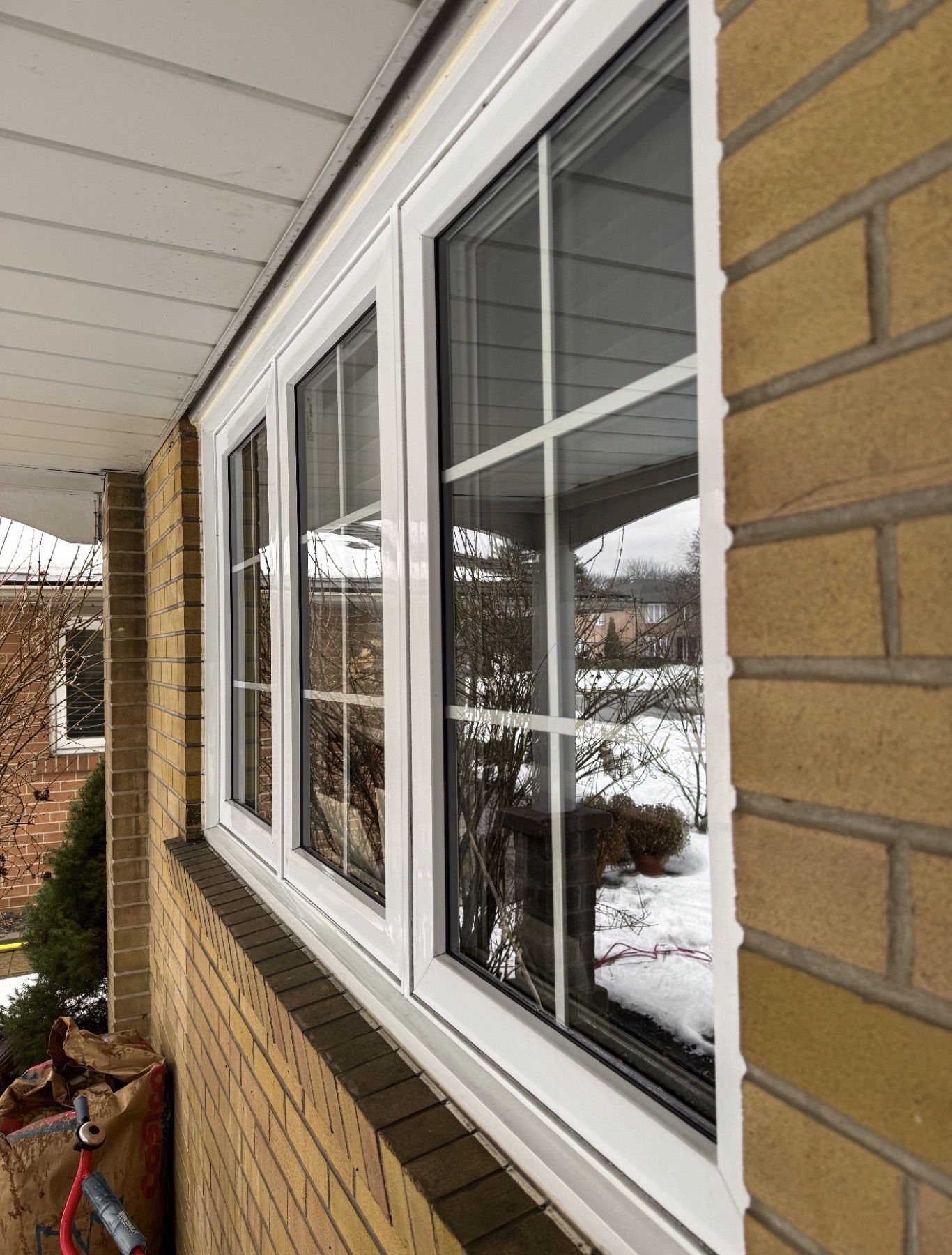
A sunny October afternoon can look like the perfect opportunity to finish a window film project. But an exterior installation has to survive the nights that follow, long after the installer has packed up.
For Toronto and the GTA, a sensible planning target is to complete exterior window film in September or earlier. Treat October as weather-dependent, and avoid relying on November for an ordinary outdoor installation. This is a scheduling recommendation drawn from local climate data and manufacturer guidance — not a fixed industry deadline or a guarantee that every September day is suitable.
The actual cutoff changes each year. It depends on the film, the temperature requirements for installation and early drying, and conditions at the building.
What counts as exterior window film?
Here, exterior film means architectural window film installed on the outside surface of building glass. The product must be approved for that exposure. A film applied to the room-facing surface of an exterior window is an interior installation and has different weather constraints.
That distinction matters when someone says window film can be installed through the winter. They may be talking about work inside a heated building.
The temperature rule extends beyond installation day
There is no single minimum temperature that applies to every exterior film.
For example, 3M’s Installation Weather Guidelines, Revision A, January 2019, instruct installers not to apply exterior film if the outdoor temperature will fall below 0°C within the next 15 days. Its exterior guidance also rules out installation during precipitation and calls for checking wind conditions.1
Avery Dennison’s architectural installation bulletin, revised February 17, 2026, specifies an air temperature of 40–80°F, approximately 4.4–26.7°C, in its exterior and security film installation section (section 4.4.5).2
These are examples from different manufacturers, not interchangeable specifications. Use the current instructions for the exact product selected. A minimum application temperature and a post-installation weather requirement answer different questions; meeting one does not automatically satisfy the other.
For a product subject to the 3M rule, a mild afternoon followed by a freeze later that week is unsuitable. A favourable short-range forecast also cannot establish conditions for the entire required period.
What Toronto’s weather data tells us
Environment and Climate Change Canada’s 1991–2020 normals for Toronto Pearson Airport show how quickly the available margin shrinks:3
| Month | Average daily high | Average daily low | Average days with a minimum at or below 0°C |
|---|---|---|---|
| September | 22.3°C | 11.6°C | 0.16 |
| October | 14.6°C | 5.3°C | 3.0 |
| November | 7.9°C | 0.2°C | 14.6 |
| December | 1.9°C | −5.0°C | 25.5 |
These are historical averages, not a forecast or a measure of glass temperature. A fractional day is an average across years.
Pearson’s published average first fall frost is October 20, calculated from 23 available years in the normal period. Subtracting 15 days gives October 5, but that arithmetic does not establish a safe installation deadline: the first freeze can arrive before the average date.3
Pearson also does not represent every Toronto property. The Toronto (City) page reports an average first fall frost of November 6, but that particular statistic uses 19 available years from 1991–2011. The station difference and incomplete records are further reasons to avoid declaring one citywide cutoff.4
For planning, leave room for weather delays before October. Later work should be assessed individually against the product instructions, the local forecast and the actual site.
What can happen if exterior film is installed too cold?
Water left beneath the film can freeze
Window film is commonly installed using a water-based solution. Squeegeeing removes excess liquid, but some moisture remains between film and glass while adhesion develops.5
3M identifies freezing residual installation water as a cause of visible film defects in its cold-weather discussion. The concern is water trapped beneath newly installed film, not simply cold air touching a finished window.1
If an unexpected freeze is followed by unusual marks or distortion, arrange an inspection. Appearance alone cannot establish whether the film will recover or need replacement.
Drying takes longer, and early adhesion is still developing
Cold conditions can prolong the drying period. Avery Dennison notes that warmer weather shortens drying and that ambient temperature, sunlight and film thickness affect the process (sections 4.4.8 and 5.1).2
The IWFA explains that adhesion increases during curing. It also distinguishes normal temporary water haze, water bubbles and distortion from defects. A newly installed film can therefore look cloudy without having failed. Conversely, a clear appearance on installation day does not prove full adhesion.5 Our curing time and aftercare guide covers what is normal to see while film dries.
A manufacturer’s required weather window should not be read as a promise of complete curing by that date. The IWFA identifies film thickness, coatings and climate as factors affecting cure time.5
Have lifting edges, worsening areas or persistent irregularities assessed rather than assuming everything will disappear in spring. Do not puncture bubbles or attempt to press them out yourself.2
Excess retained solution can cause problems beyond temporary haze
Madico warns that residual application solution can interfere with close contact between the film and glass and contribute to bubbles and other installation defects. For certain slow-drying films containing aluminium, retained water can also cause deterioration of the metal layer, known as demetallization. This is product-dependent; it is not a claim that every cold installation will peel or corrode.6
Required edge sealing can be compromised
Some exterior systems require a compatible sealant around the film perimeter. Madico’s guidelines require edge sealing for its exterior films to protect against moisture penetration and UV degradation at the edges, and make proper sealing a warranty condition.6
Sealant has its own requirements. Dow’s cold-weather guidance requires clean, dry, frost-free surfaces and explains that curing can slow in cold conditions. Some listed silicones can be applied below freezing under the prescribed conditions; that does not give permission to install the accompanying window film below its own limits. Both parts of the system must meet their instructions.7
Does an exterior film have to come off for winter?
An exterior film approved for the location is intended to remain installed through its service life. The vulnerable period discussed here is installation and early drying. Exterior products are sold with multiyear coverage — for example, Solar Gard’s Canadian warranty includes its Sentinel Plus OSW exterior range. That coverage still depends on the applicable product and installation conditions.8
Choose the film for the glazing and exposure first, then schedule the work to suit its requirements.
Can the work move indoors instead?
An approved interior film may be an option, depending on the glass and the purpose of the installation. Interior work has a different cold-weather assessment: 3M’s guidance considers the interior glass and frame temperatures and overnight building heating, with a minimum interior pane temperature of approximately 4.4°C.1
Moving the same exterior product to the inside is not automatically an acceptable substitution. Ask the installer to confirm a suitable film-to-glass application.
Planning an exterior installation in Toronto
Arrange a site assessment early enough to identify the product, confirm exterior suitability and allow for required edge sealing and weather delays. Before accepting a late-season date, ask the installer to confirm:
- The exact film and its current installation temperature requirements.
- Any required period without freezing after installation.
- How air, glass and perimeter conditions will be checked.
- The edge-sealing requirements and the plan if conditions deteriorate.
If exterior film is on your list for this year, contact ImpactGuard before the fall weather becomes the deciding factor. An early assessment gives you time to schedule suitable conditions — or choose a spring installation without rushing the work into a marginal weather window.
Research checked October 6, 2026. Manufacturer examples apply to their respective products; confirm current product-specific instructions before scheduling.