
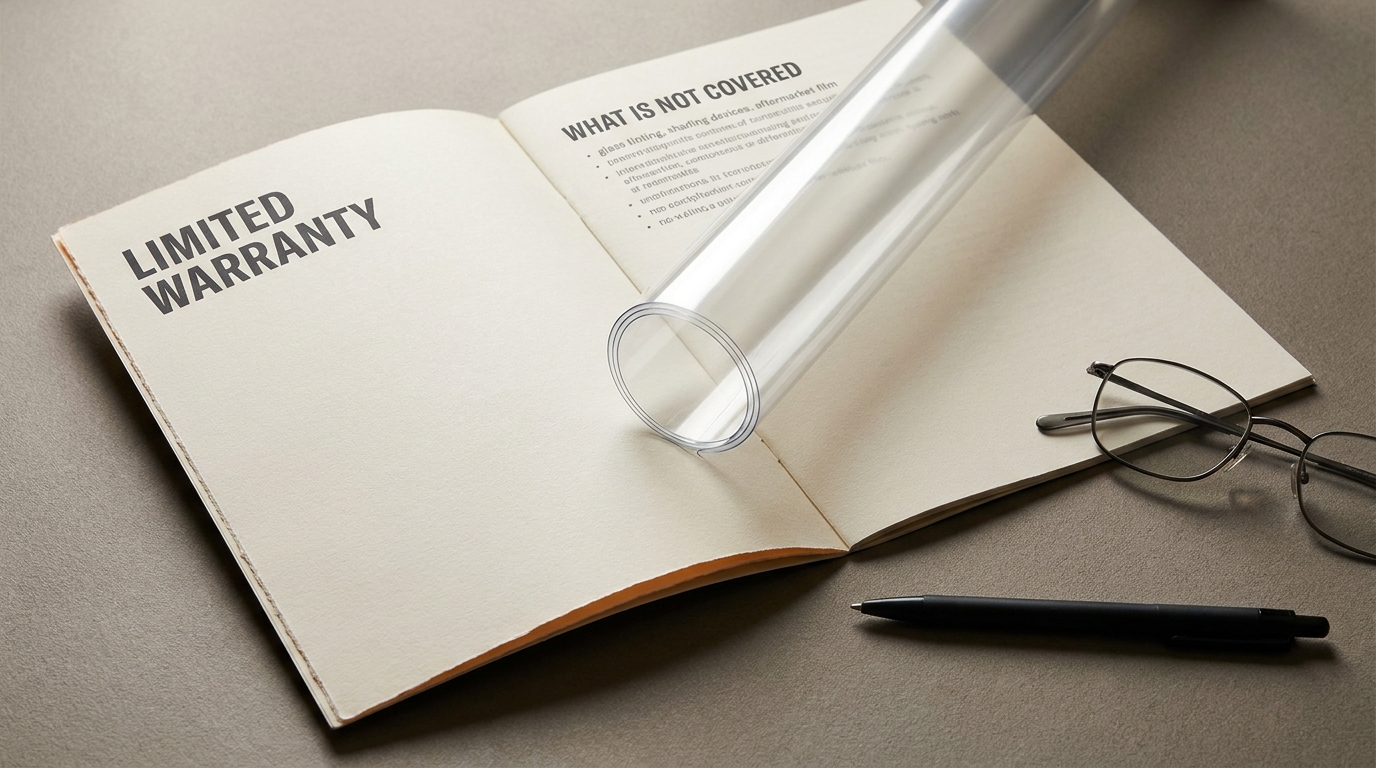
It is one of the first questions a homeowner asks me, usually before we have even talked about the glass: if I put film on these windows, does it kill my warranty? It is a fair question, and the honest answer is yes—but not the warranty most people are picturing, and not for the reason they assume.
The warranty at risk is your window manufacturer’s glass warranty—the one that covers the sealed insulated glass unit against seal failure and premature glass defects. Aftermarket film does not touch your film’s own warranty, and it does not touch the frame, hardware or weatherstripping coverage. It specifically lands on the glass. And in most cases that clause is written for a problem that clear security film simply does not cause. Let’s walk through who voids, who hedges, and why the distinction matters in Ontario.
Which window manufacturers void the warranty outright?
Some manufacturers leave no ambiguity at all. Andersen, one of the most common premium window brands in Canadian homes, spells it out in its limited warranty under “What is NOT covered.” The clause excludes any failure, damage or cost due to “product modifications or application of glass shading devices, glass tinting, or insulated coverings.”1 Aftermarket window film is glass tinting by another name. Once it is on the glass, Andersen’s 20-year (or 10-year, depending on the line) glass and seal coverage no longer applies to that unit.
Read the clause carefully and one thing stands out: it bundles “glass tinting” in with “insulated coverings” and “shading devices.” The manufacturer is not singling out high-performance security film. It is drawing one broad line around anything added to the glass after it leaves the factory that could change how the unit handles heat. That framing is the key to the whole article, and we come back to it in section 04.
Andersen is not alone in the flat-exclusion camp. Across the premium residential window market, the manufacturers who void most cleanly tend to share the same trigger: an aftermarket film applied to a sealed insulated glass unit without the manufacturer’s prior written approval. If your windows are Andersen—or any brand whose warranty names tinting or films directly—assume the OEM glass warranty is gone the moment film goes on, and plan accordingly. The good news, in section 05, is that “gone” does not have to mean “unprotected.”
Which manufacturers are ambiguous about it?
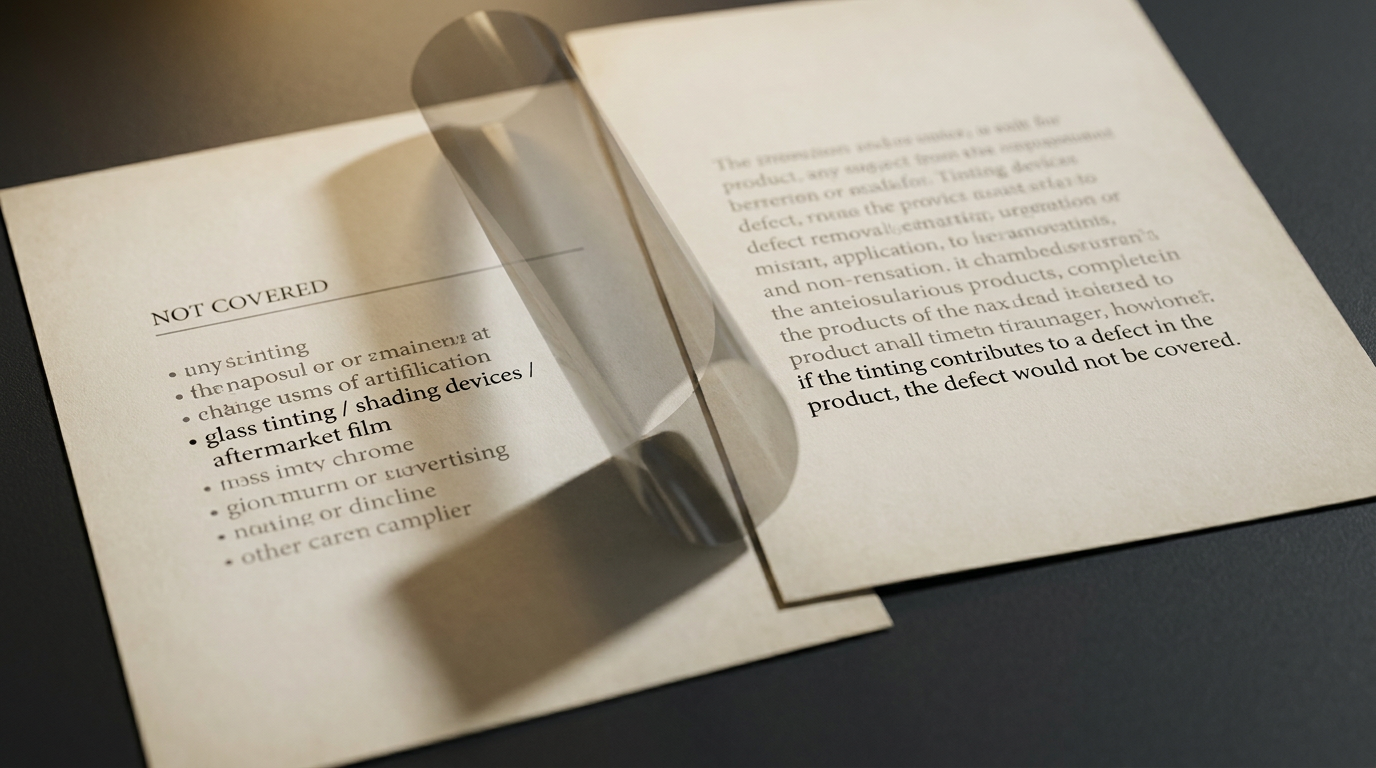
A second group does not void automatically—they void conditionally. Pella is the clearest example. Pella’s own customer guidance on tinting its products states that the company does not prohibit aftermarket film, but that “if the tinting contributes to a defect in the product, the defect would not be covered under the warranty.”2 In other words: put film on, and if the film is later judged to have caused the failure, you own it. If something unrelated fails, you may still be covered. The burden sits on the film.
Marvin occupies similar ground. Marvin’s limited warranty does not list aftermarket film as a flat exclusion the way Andersen does, but it does exclude damage from causes outside normal use and explicitly does not warrant against the thermal-performance consequences of modifications to the glazing.3 The practical effect is the same conditional posture: a film that causes a thermal-stress crack is your problem; a defect unrelated to the film may still be argued.
This conditional camp is where most of the confusion—and most of the bad blanket advice—comes from. “Film voids your warranty” is too strong for Pella and Marvin. “Film is totally fine” is too weak. The accurate statement is that these manufacturers reserve the right to deny a glass claim if the film is the cause. Which, again, points straight at the real variable: what kind of film, and how much heat it traps.
Why does the clause exist in the first place?
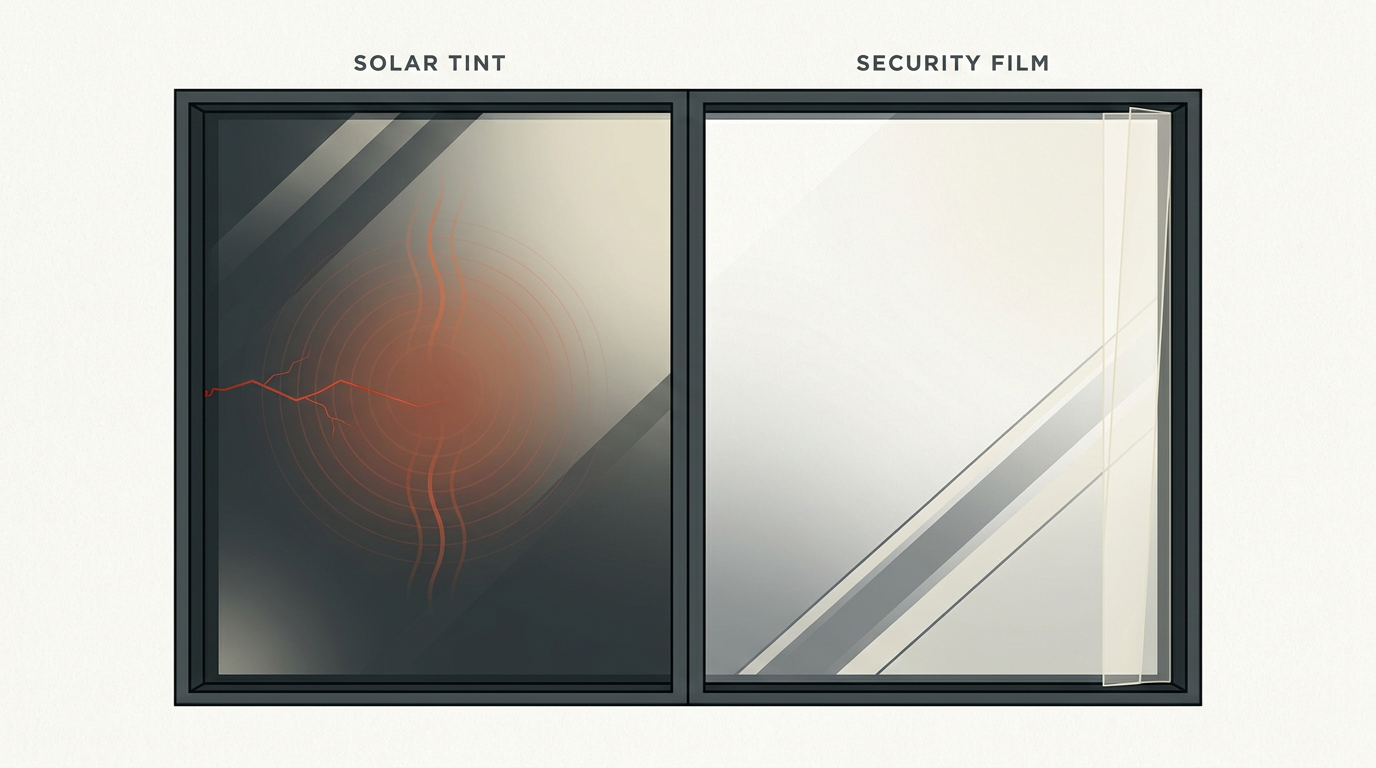
Manufacturers did not write these clauses to be difficult. They wrote them because of a real, well-documented failure mode: thermal stress fracture. When a film with high solar absorption is applied to glass, the film absorbs solar energy and re-radiates it as heat into the pane. The centre of the glass heats faster than the edges, which stay cooler because they are gripped by the frame. That temperature differential makes the centre want to expand while the edges hold it back—and on annealed glass, the pane can crack from the stress alone, with no impact at all.4
The numbers are stark. Annealed glass—the most common glass in older residential windows—can fail from a temperature differential of roughly 35–58 °C across the pane. Tempered glass tolerates differentials up to roughly 250 °C and is effectively immune. The risk is not theoretical for sealed insulated units either: a dark or reflective film on the inner pane of a double-glazed unit can drive heat buildup that stresses the seal and leads to premature seal failure—exactly the failure the OEM warranty covers.4
So the clause is really a solar-film clause wearing a broad coat. It exists to protect the manufacturer from claims where a heavily absorptive tint cooked the glass or stressed the seal. That is a legitimate risk—for the wrong film, on the wrong glass. The trouble, as we will see, is that the clause as written does not distinguish between the film that causes the problem and the film that does not.
Why security film gets swept into a solar-film problem.
Here is the part that genuinely frustrates us. The thermal-stress problem is a solar-control problem. It is driven by absorption—dark, reflective, ceramic and heavily tinted films that soak up solar energy. Clear security film is the opposite kind of product. It is transparent: it lets visible light through, blocks UV, and absorbs very little heat. On the absorption scale that drives thermal stress, a clear safety/security film sits near the bottom, which is why it is widely considered safe for dual-pane and Low-E glass.5
In other words, the exact mechanism the warranty clause was written to guard against—heat buildup from an absorptive film—is the mechanism clear security film is least likely to trigger. A professionally installed clear 8–14 mil security film simply does not load the glass with heat the way a dark solar tint does. The failure mode the manufacturer is worried about is, for this product, close to a non-issue.
And yet security film is wrapped into the same clause. Because the warranty language says “glass tinting” or “aftermarket film” in the broadest possible terms, a clear, low-absorption security film gets treated identically to a limousine-dark solar tint. The product that poses the real risk and the product that poses almost none are voided by the same sentence. It is a blunt instrument, and security film is collateral damage—swept in not because it causes the failure the clause targets, but because it shares the word “film.”
The part nobody tells you: premium film carries its own glass warranty.
Now the reassuring half of the story. Yes, applying film may void your window manufacturer’s glass warranty. But premium film manufacturers—Madico, 3M and other reputable brands—anticipated exactly that. They carry their own glass-breakage and seal-failure warranties that step in precisely because the OEM warranty steps out. The film maker is, in effect, taking over the coverage the window manufacturer dropped.
3M is explicit about this. Its window-film warranty provides glass breakage (thermal-shock) coverage for up to five years from installation, and—critically—“3M will match the OEM glass manufacturer’s seal failure warranty if the application of window film voids the OEM warranty.”6 Its upgraded Platinum coverage matches the terms of your existing window manufacturer’s warranty, line for line, raising the per-window replacement value to $1,500. The void is designed to be backfilled.
Madico structures it the same way. Windows with Madico film are covered against breakage and seal failure due to thermal stress for a defined period, and the company runs a dedicated glass-breakage / seal-failure claim process—with a Canadian service line for Ontario homeowners.7 The detail that tells you everything: Madico’s seal-failure claim requires proof that the window manufacturer’s warranty would have been in force had no film been installed. The film warranty is explicitly written to assume the OEM warranty is the thing being replaced.
This is why who installs your film, and which film matters more than the void clause itself. A reputable, certified install of a premium film does not leave you with a hole in coverage—it swaps one warranty for another that is, in the seal-failure case, designed to match. A bargain film from an uncertified installer gives you the void with no net underneath.
What this means for an Ontario homeowner.
Pull it together and the decision gets simpler than the fine print suggests. If your windows are from a flat-exclusion manufacturer like Andersen, the OEM glass warranty ends when film goes on—so the film you choose, and the warranty behind it, is the coverage you are actually buying. If your windows are from a conditional manufacturer like Pella or Marvin, the OEM warranty survives unless the film is judged to have caused the failure—so a clear, low-absorption security film, professionally installed, keeps that risk close to zero.
Either way, the move is the same: choose a clear, low-absorption security film from a manufacturer that carries its own glass-breakage and seal-failure warranty, and have it installed by a certified installer who will document the job. That combination protects the glass, keeps the thermal-stress risk that the OEM clause fears off the table, and replaces any voided seal coverage with a film-maker warranty written to match it.
If you want, we will read your specific window manufacturer’s warranty with you before anything goes on the glass, tell you plainly whether it is a flat-void or conditional clause, and show you exactly what the film’s own glass and seal warranty covers in its place. We install clear security film across the GTA and typically schedule assessments inside 48 hours.