
Security window film is one of those products where almost everyone has heard the name, very few people have seen one installed, and almost nobody can describe what it actually does to the glass. The category is older than most homeowners realize. The physics is simple. And the difference between a good install and a bad one is small enough that most buyers miss it on the showroom floor and only find out the hard way.
This is the plain-language version of how security window film works, written for Toronto and GTA homeowners who want to understand the product before they price it. No specs you do not need. No fear-marketing. No talk about pricing until the last section.
What is security window film, physically?
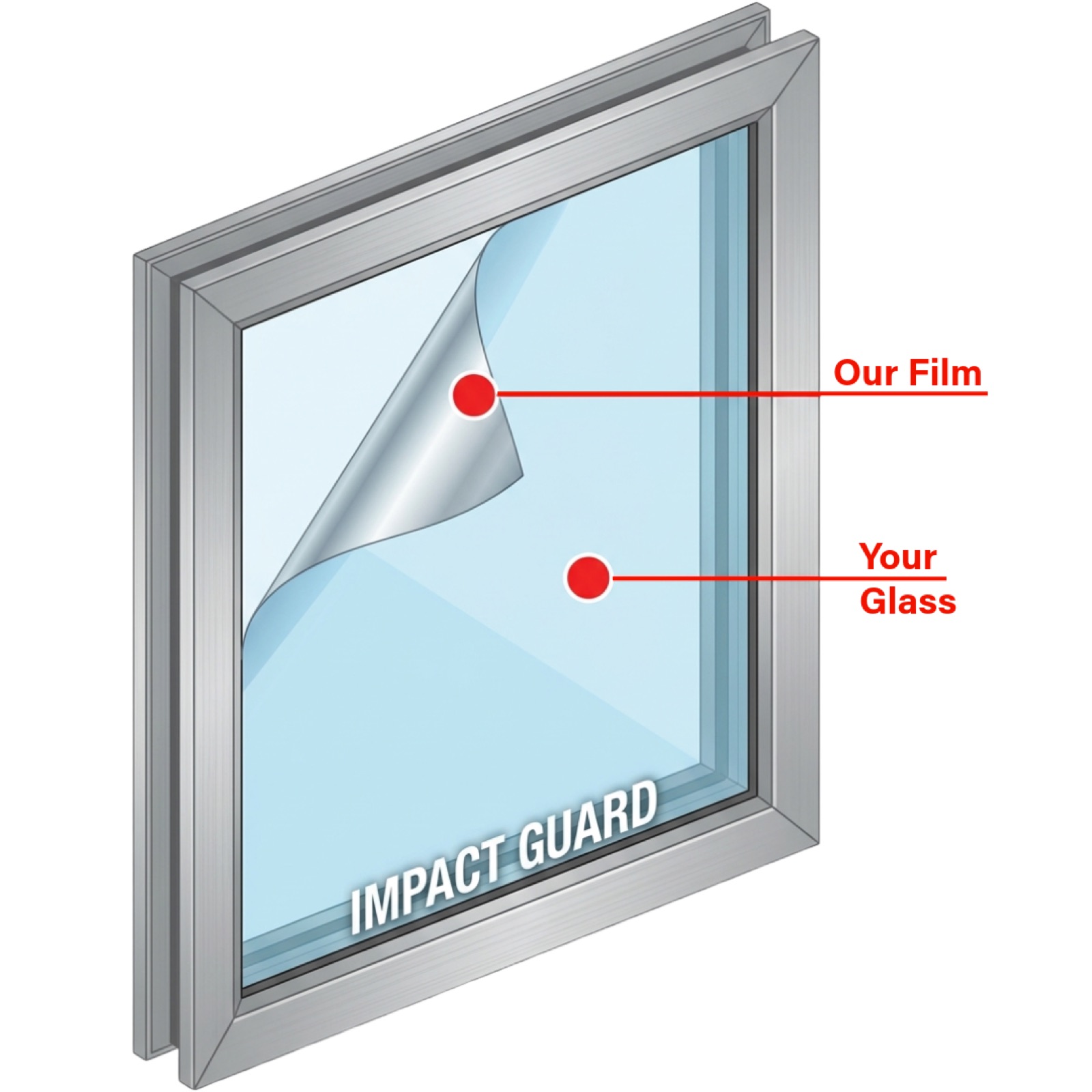
Security window film is a clear sheet of polyester (the same family of plastic as a soft drink bottle, but heavily engineered for optical clarity and tensile strength), bonded to the inside face of an existing window with a permanent pressure-sensitive adhesive. The film itself is somewhere between four and fourteen thousandths of an inch thick. The product ImpactGuard installs across the GTA is fourteen thousandths, written as 14 mil — the top of that range, and a step heavier than the 12-mil spec most security installers run. We source from established manufacturers like Madico and Solar Gard, which have been making professional-grade architectural and security films for decades. That is roughly three and a half times the thickness of a kitchen garbage bag, or about the thickness of two business cards stacked.
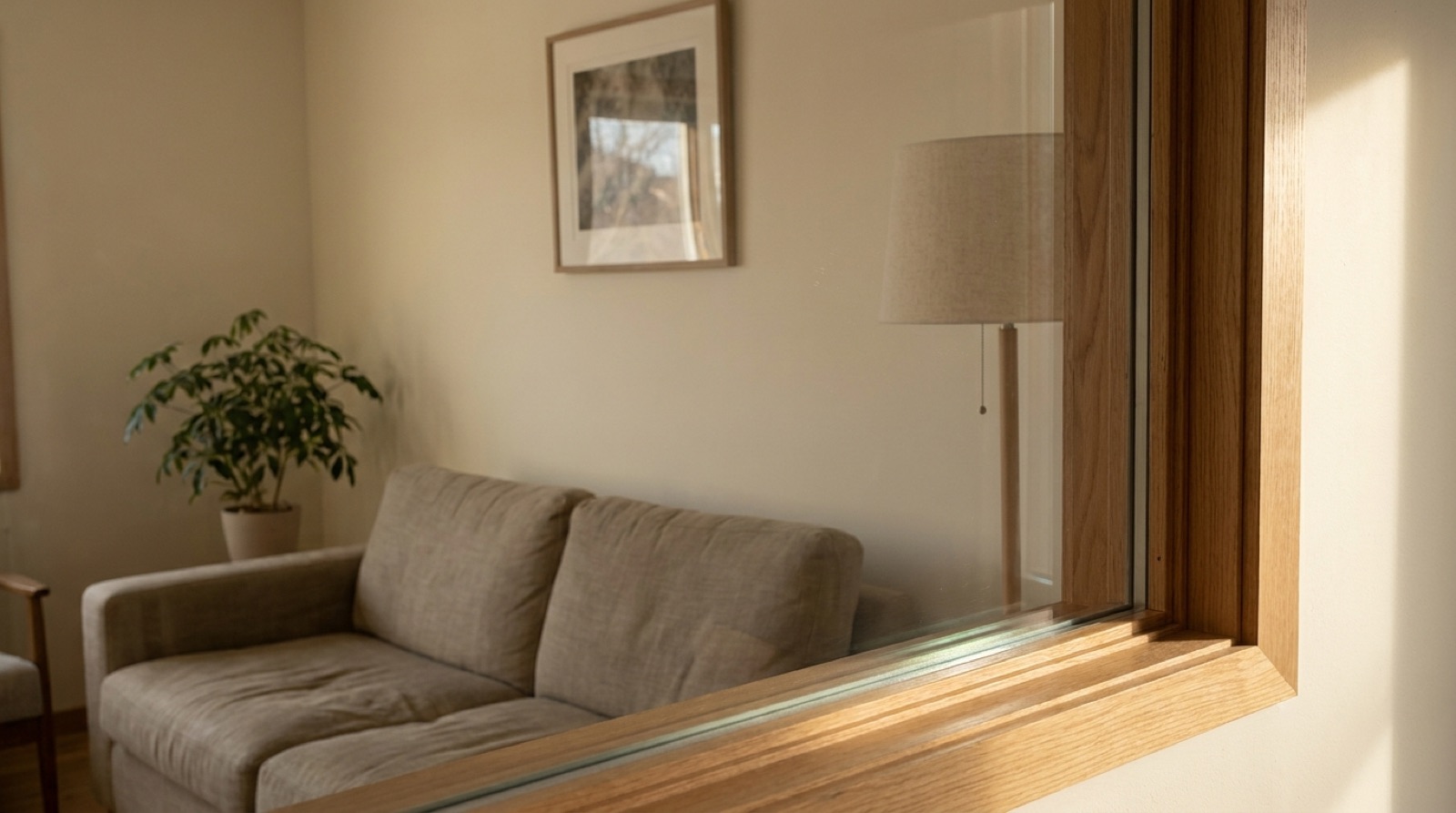
Once it is installed and cured, the film is invisible to the naked eye. There is no tint, no mirroring, no haze. From the street, your windows look identical to the day before the install. From inside, the same. You can wash the glass normally with the same products you used before. The only way someone could tell the film is there is by running a fingernail across the inside surface and feeling the slight ridge where the polymer ends at the frame.
That is the entire material story. A clear sheet of tough polyester, glued tight to your existing glass, finished so cleanly that nobody knows it is there.
How does the film actually slow down a break-in?
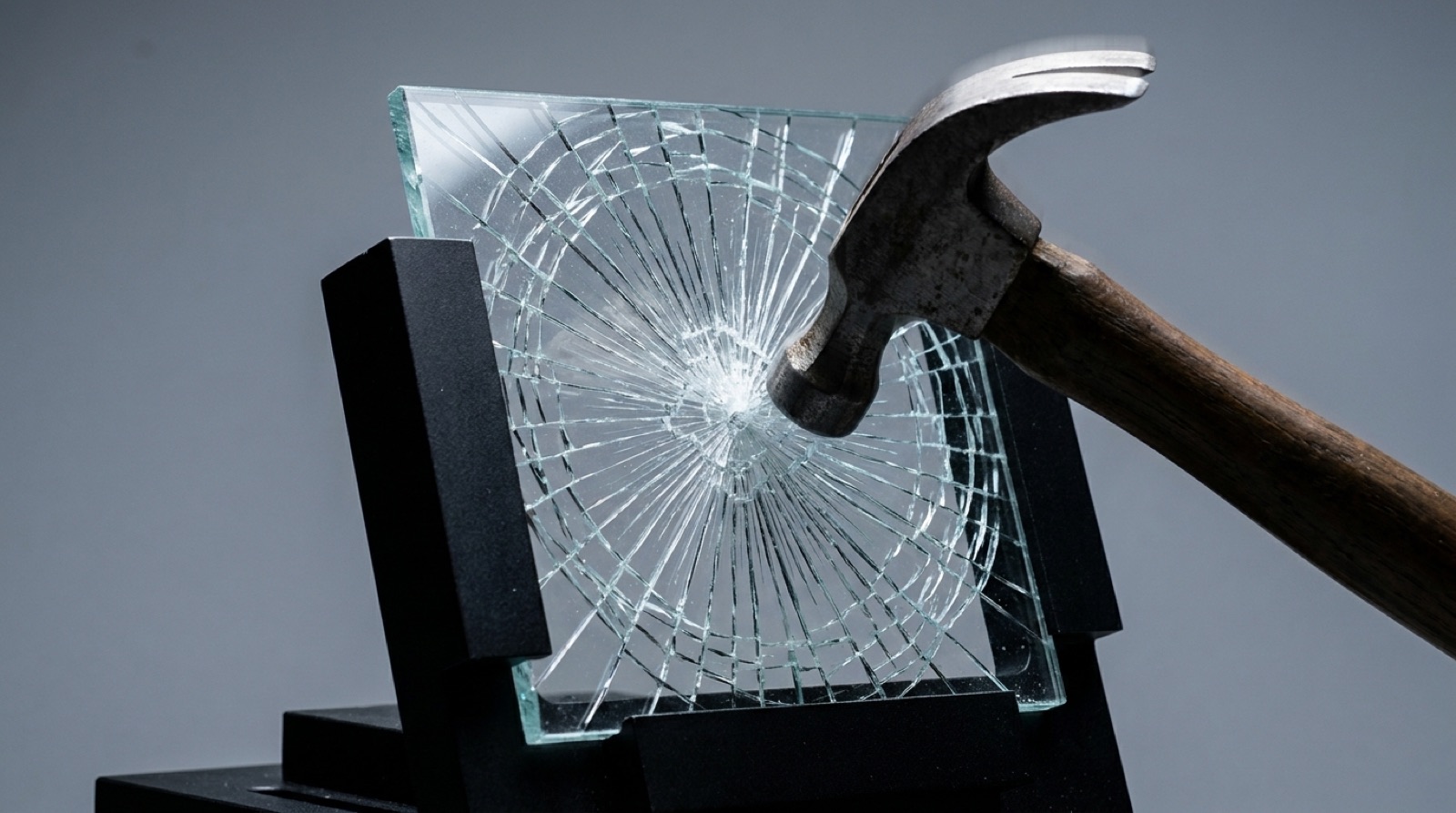
To explain this, it helps to know how a normal residential window fails. Standard residential glass is annealed glass. Under a focused impact (a hammer, a brick, a spring-loaded window punch, the sharp end of a pry bar), an annealed pane cracks and the cracks propagate fast. Within three to six seconds, the glass fragments fall out of the frame and the opening is clear. From the outside, what you see is one loud hit and a clear hole.
Security film changes that sequence in two specific ways.
First, the polyester sheet has very high tensile strength. When the glass cracks, the fragments do not fall away from the opening. They stay bonded to the film. The pane behind the film is now broken, but it is still in the frame, still roughly square, and still in the way.
Second, every additional hit has to defeat both the glass and the film at the same time. The attacker now has to either push the entire bonded sheet inward through the frame, or cut through the film with a knife or a saw. Both are dramatically louder, slower, and more visible from the street than a single broken pane. The break-in moves from a quiet, fast event to a loud, drawn-out one. That is the entire point of the product.
How long a filmed opening actually holds is not a number anyone can honestly put on a page. It depends on the attack tool, the base glass, the frame, and the install quality, and an attacker with a pry bar is a different problem than one with a rock. What is consistent is the shape of it: the quick strike stops working, and the only way through is a loud, repeated, visible assault on the same opening. That is the reason most opportunistic break-in attempts get abandoned. While the attacker is still working, an alarm has reported, a neighbour has looked out a window, and the math has stopped working for the person on the other side of the glass.
Where does security film stop working?
Two honest limits.
The frame edge is the whole install. A film applied only to the face of the glass, stopping short of the frame, will pop the entire sheet (film and broken glass together) out of the window under enough force. This is the difference between a decorative install and a real forced-entry barrier. Properly installed security film is either anchored to the frame with a bead of structural silicone (we use Dowsil 995) or wrapped right to the edge with a tight tolerance. If a quote does not specify either, the install is paying for the film and skipping the part that actually does the work.
The film does not turn glass into a wall. A determined attacker with five minutes, a saw, and no audience will eventually defeat any residential glazing on the market, film or no film. What security film does is make that fight loud, slow, and obvious in front of every neighbour on the block. The product is a deterrent and a delay, not a vault door, and the people selling it like one are not telling you the truth.
What does “UL-972 rated” actually mean?
UL-972 is the North American standard for burglary-resisting glazing material. It is published by Underwriters Laboratories and tested in a lab. The test is not abstract. A steel ball gets dropped on the treated pane, then a human attacker comes at the same pane with a hammer for a fixed time window. Films and glazings that pass hold long enough to matter. Films that do not pass do not get the rating.1
Two things to know about the rating. First, UL-972 certifies the material. It does not certify your install. A UL-972 film that is applied poorly, with no anchored edge, will not perform the way the lab test does. That is why a certified film with a sloppy installer is worse value than a slightly cheaper film with a careful one.
Second, the rating is the language insurance brokers and commercial property managers actually recognize. If you are thinking about a film install partly to support an insurance conversation (a real, modest benefit on the commercial side), UL-972 is the credential to ask for by name.
What does an ImpactGuard residential install actually look like on the day?
For most GTA homes, a whole-home install is a one-day job. A typical sequence:
Walk-through. We measure every opening to the edge of the frame. Every door, every ground-floor window, every basement pane, every patio slider. You see the same numbers we work from. We do not estimate from photos.
Surface prep. The inside face of every pane gets cleaned to a contaminant-free surface. Old residue, dust, and finger oils all get removed. This is the step cheaper crews skip, and it is the step that decides whether the film bonds for twenty years or starts lifting at the edges in two.
Cut and apply. The film is cut to the exact glass dimension, applied wet, and squeegeed flat with a soft edge. Bubbles are worked out from the centre. The film is trimmed at the frame.
Edge anchoring. A controlled bead of structural silicone is run between the film edge and the window frame. This is the load-transfer step. Without it, the film floats; with it, the glass, film, and frame become one connected unit.
Documentation. Every job leaves with photos, a UL-972 spec sheet, and a signed certificate of completion. Insurance brokers ask for these by name on commercial files. Homeowners keep them with the rest of their home records.
Working bond inside 24 hours. Full cure in three to four weeks. You can use the windows normally from day one, and nothing about the look of your home changes.
Is security window film actually worth installing in a Toronto home?
For ground-floor openings on most GTA single-family homes, yes. Patio sliders, basement windows, front-door sidelights, and rear ground-floor bedrooms are the openings that get worked in real break-ins, and those are the openings where film changes the math. Upper-floor and second-storey windows are usually not worth filming, because nobody is going up a ladder for an opportunistic job.
The pricing answer is short. We charge $18 per square foot of glass, fully installed, plus $3 per linear foot of window perimeter for the structural silicone edge bead that anchors the film to the frame. Both lines are on every quote, with a manufacturer-backed warranty on the film — on a home, lifetime on interior installs and 10 years on exterior; on a commercial property, 16 years on interior installs. No service-call fee. No surprise add-ons. If you want to know what your home would cost, measure your ground-floor openings yourself and multiply the square footage by about 21; you will be inside ten percent of the right number before we ever drive out.
We do an in-person walk-through for free across Toronto and the GTA. You get a written, fixed quote on the spot. If the number works for you, we book the install. If it does not, you have a real number you can compare against any other installer who quotes you, and that is its own kind of useful.