
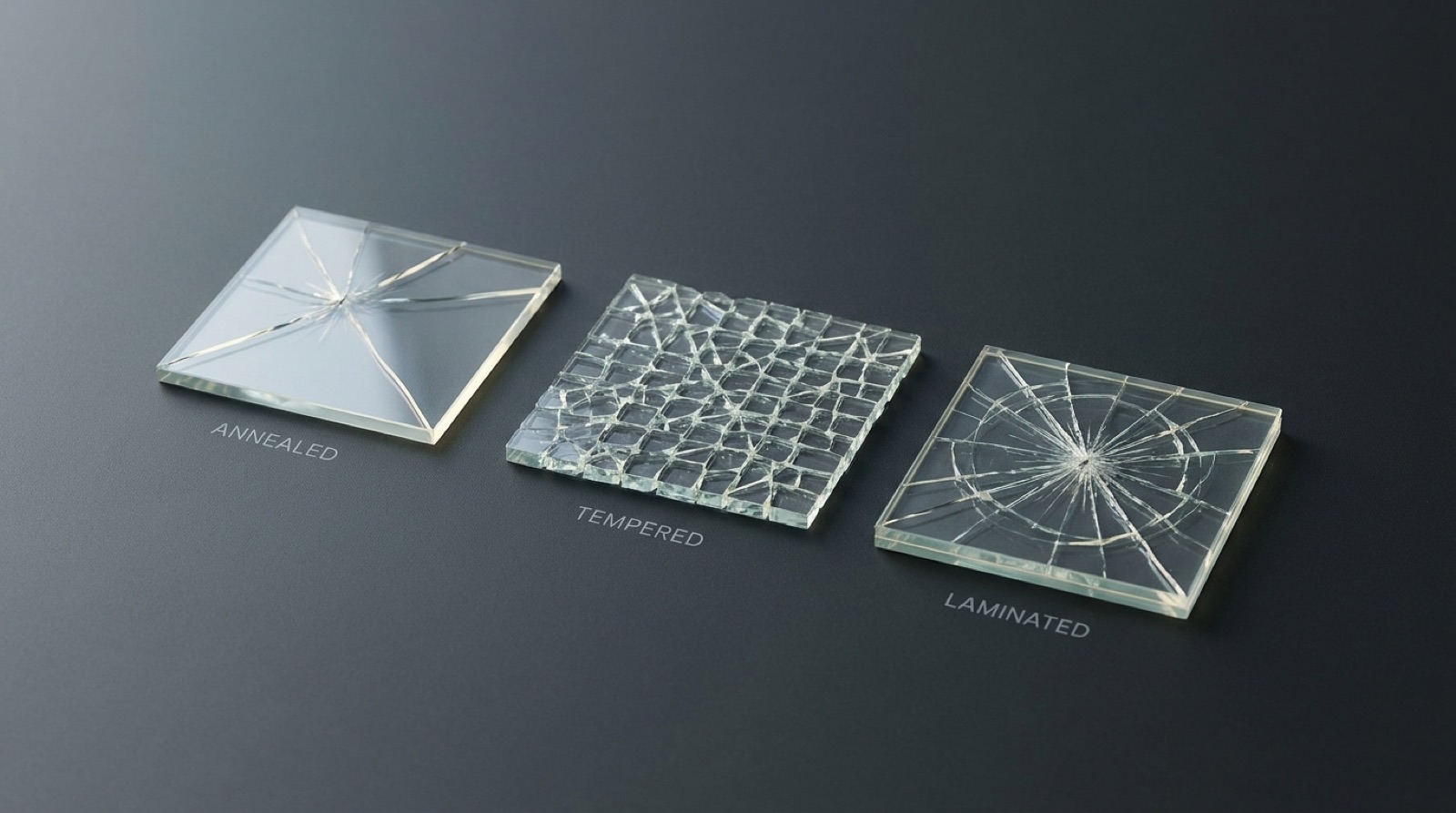
The glass in your Toronto house is almost certainly one of three things, and most homeowners have no idea which. The distinction matters because each type fails in a very different way, both under accidental impact and under forced entry.
This is a glossary. No sales pitch. By the end of it you should be able to walk up to any window in your home, look at the edge, and make a reasonable guess at what’s in the frame.
What is annealed glass, and why does almost every Toronto home have it?
Annealed glass is standard float glass, cooled slowly in a controlled oven so internal stresses balance out. It’s the glass most Canadian home windows are glazed with, the glass in picture frames, the glass in most interior partitions and non-safety applications. If your builder didn’t specify otherwise, your house has annealed windows.
The failure mode is what you’d expect: large sharp shards. Annealed glass fractures into long pointed pieces that fall out of the frame when hit. It’s why the Ontario Building Code and CSA A440 require tempered or laminated glass in specific safety-sensitive locations (near bathtubs, next-to-door sidelights below a certain height, low-level glazing in stairwells) but allow plain annealed everywhere else.1
How to identify it. Annealed is the default if no other markings are present. Look at the corners. A tempered pane carries a permanent etched bug in one corner. Laminated glass shows a visible interlayer at the cut edge. No bug, no interlayer, single sheet: annealed.
Is tempered glass actually more secure against break-ins?
Tempered glass is annealed glass that has been reheated and rapidly quenched, introducing a compression layer on the outside and tension in the centre. The finished pane is about four times stronger in bending than the equivalent annealed sheet, and when it finally fails it fractures into small roughly-cubic pieces rather than long shards. This is why tempered is specified for patio doors, shower enclosures, storm doors, low-level windows, car side glass, and anywhere else a broken pane would create a cut-injury hazard.
Two things people get wrong about tempered glass, all the time.
First, it’s a safety product, not a security product. The cube-shattering failure mode protects people from lacerations. It does not protect the home from intrusion. A tempered pane hit with a focused tool (a spring-loaded window punch, a ceramic spark plug fragment, the sharp end of a claw hammer) fails catastrophically and instantly. Once a tempered pane is defeated, it comes down all at once, not in pieces you have to work through.
Second, tempered glass cannot be cut after manufacture. Any shaping (edge work, holes, notches) has to be done to the annealed stock before tempering. Which matters for security films and add-ons: anything applied to the inside face of a tempered pane has to be installed without drilling or scoring the glass.
How to identify it. Look for a small etched or sandblasted logo in one corner of the pane, usually no bigger than a fingernail. Canadian suppliers typically etch the brand name plus a CAN/CGSB safety-glass designation. If the corner has a bug, the pane is tempered.2
What is laminated glass, and does it stop break-ins?
Laminated glass is two (or more) layers of glass bonded to a clear polymer interlayer, almost always polyvinyl butyral (PVB) in residential contexts, occasionally ionoplast (SGP) in premium commercial work. The sandwich behaves very differently from either annealed or tempered glass alone. When the outer layer cracks, the fragments stay bonded to the interlayer. The pane holds its shape.
You’ve seen laminated glass a thousand times without thinking about it. It’s the windshield of your car, and it’s the glass in most large storefront systems built to Ontario Building Code in the last fifteen years. In residential construction it’s still optional, common in higher-end custom builds and in hurricane-code retrofits nobody in the GTA needs.
Laminated glass adds genuine forced-entry delay. The PVB interlayer does not magically stop a determined attacker, but it does convert a single six-second-failure event into a sustained attack problem. The attacker can crack the pane in seconds. Removing enough of the bonded sheet to climb through takes meaningfully longer, often long enough for an alarm dispatch chain to matter.3
How to identify it. Look at the edge of the pane where the glass meets the frame, or the exposed cut edge of a sample piece if you have one. A faint horizontal line in the middle of the glass thickness is the PVB. On a double-glazed unit, each pane in the unit is a single sheet, so don’t confuse the air-gap separator for an interlayer. Laminated is the pane that looks like a sandwich when you view it edge-on.
Can security film give my annealed windows the strength of laminated glass?
Most GTA homeowners asking about security upgrades are looking at annealed or tempered glass and thinking about retrofitting the performance of laminated glass without replacing the windows. That’s a fair read of the product category. Security window film, applied properly, approximates the laminate behaviour by bonding a tough polyester sheet to the inside face of the existing pane so that when the glass fractures, the shards stay bonded to the film.
Two honest limits. The film is only as good as the installation, specifically at the frame edge (that’s its own field note). And the base glass still matters. Security film on a tempered pane behaves differently than on an annealed pane, because when tempered fails it fails all at once, so the film has to carry the entire load of the shattered sheet in tension. On annealed, the shards stay in roughly the right shape, and the film holds them there.
The right answer usually isn’t “rip out your windows and install laminated.” For most residential jobs that’s tens of thousands of dollars and weeks of site disruption. The answer is: know what you have, decide which openings actually need upgrading (ground-floor patio doors and ground-floor bedroom windows almost always, upper floors usually not), and choose a retrofit product that matches those specific openings.
How can I tell what type of glass is in my own windows?
You now have enough to tell the difference. Bug in the corner: tempered. Visible horizontal line at the cut edge: laminated. Neither: annealed. For most Toronto houses, what you’ll find is a mix, with tempered on the patio doors and annealed on everything else. That’s code-minimum, and code-minimum is the starting line for any conversation about forced-entry resistance, not the finish.
Whatever you decide to do after that, at least now you’re deciding from the right information.