
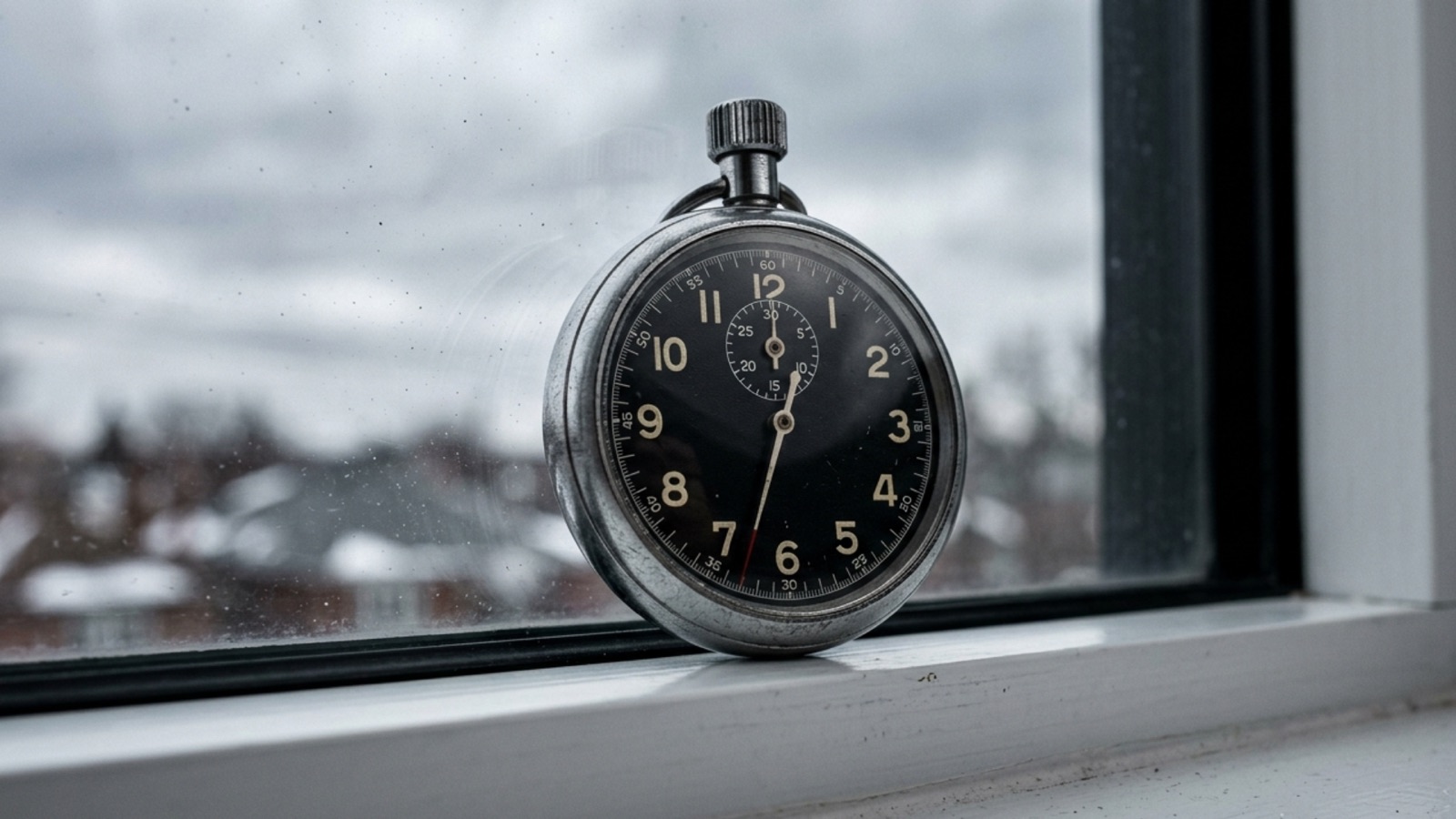
People overestimate how long a break-in takes by roughly two orders of magnitude. Homeowners picture a careful intruder, gloves on, picking a lock for several minutes in the dark. The real thing is faster, louder, and over before most alarms finish their own countdown.
This piece is a timing breakdown. We’re going to walk from the first strike on the glass to the moment an intruder is inside, then compare that clock to what an alarm system is actually doing during the same window. No product pitch. Just the numbers, so the rest of your home-security decisions get easier.
How fast can someone actually break a residential window?
Most Canadian residential windows are annealed glass, the standard float product that’s cheapest to make and easiest to replace. It also happens to be the glass most likely to be on a ground-floor patio door or a back bedroom. A focused impact from a landscaping rock, a spring-loaded window punch, or a framing hammer produces a clean fracture in under five seconds. In plain English: one strike, maybe two, and the glass is through.
Tempered glass, the stuff used in shower enclosures and some exterior doors, fails slightly differently but not more slowly under attack. It shatters into small cubes rather than long shards, which reads safer from a liability standpoint but does not buy meaningful delay. A tempered patio door hit with a window punch goes from one intact sheet to a pile of cubes on the floor in under a second.
Laminated glass is the only stock residential product that adds real forced-entry delay, because the PVB interlayer between two panes holds fragments together. Most GTA homes don’t have it. You can ask your builder or check the edge of the pane for a visible interlayer if you’re not sure.
What is your alarm actually doing in the first 60 seconds?
Most monitored residential alarm systems in the GTA run on a standard dispatch chain. The sensor triggers. The panel runs a short entry-delay countdown (usually 30 to 60 seconds for front-door codes, often shorter or zero for glass-break and motion). A signal goes to the monitoring centre. The operator calls the homeowner, then the secondary contact, then the police non-emergency line if neither answers.
Three things tend to surprise people about this chain. First, the police are not called the instant the alarm fires. Second, police in most Canadian jurisdictions do not dispatch to an unverified residential alarm as a priority call. Toronto Police Service downgraded unverified alarm response years ago, matching most large urban services, and prioritizes calls with a confirmed witness, audio, or video of the intrusion. Third, even a priority call is not an instant response. Typical Priority 1 response across the city averages in the six to ten minute range on a quiet night, longer in busy divisions or during peak demand.1
Add it up. The sensor fires. Sixty seconds later, the monitoring centre is still on the phone to you. A few minutes after that, if you don’t answer, police are requested. Six to ten minutes after that, a unit arrives. The entire chain assumes the glass is still in the way.
How long does a burglar actually stay inside your home?
A long line of burglar-interview research, most famously the FBI Law Enforcement Bulletin and a National Institute of Justice study of convicted residential burglars, converges on a strikingly short time-on-target window. The median residential burglary takes between eight and twelve minutes from entry to exit. A large share wraps up in under five minutes.2
The tight window isn’t cautious behaviour. It’s deliberate. Experienced burglars know the dispatch chain as well as anyone, and they plan around it. The entry point is chosen for speed. The target rooms (primary bedroom, office, living room) are hit first. Small high-value items (cash, jewellery, watches, prescription narcotics) go into a bag. Everything else is ignored.
The implication is unpleasant and useful. If someone is going to spend ten minutes inside your home, the fight isn’t for minute eleven. It’s for minute zero. Anything that adds delay at the entry point (not inside the home, at the window or door) is worth more than anything that happens after they’re already inside.
Why is the glass the only timing variable you control?
Look at the timing side by side. Glass failure, three to six seconds. Monitoring-centre verification, one to two minutes. Police dispatch request, a couple minutes after that. Arriving unit, six to ten minutes after dispatch. Burglar time-on-target, eight to twelve minutes.
Every line on that list except the first one is out of your hands. You can pay for faster monitoring. You can argue with policy on unverified-alarm response. You can’t shorten Toronto Police’s average arrival time, and you definitely can’t shorten the burglar’s work pace.
The glass is different. The glass is the only link in the chain you actually own. A window that fails in six seconds and a window that resists for several minutes produce completely different incident reports. In the first case, the attacker is inside before the monitoring centre dials you. In the second case, the attempt is still outside when the dispatch chain catches up, and a meaningful share of attempts simply end with an abandoned attack and a cracked but intact pane.
UL 972, the North American standard for burglary-resisting glazing, exists precisely to put a number on that difference. A laboratory test drops a steel ball on the pane, then sends a human attacker at it with a hammer inside a fixed time window. Materials that pass resist long enough to matter. Materials that don’t, don’t.3
Alarms react. Glass buys the time alarms assume you have.
None of this is a reason to skip an alarm. Monitored alarms matter. Cameras matter. Motion-activated lighting matters. They all do work that glass can’t do. But every one of those systems is built on the assumption that the glass holds long enough for the rest of the chain to catch up. On a standard annealed pane, that assumption is off by roughly two orders of magnitude.
If you take one number away from this piece, make it six seconds. That’s the timer on your current glass. Every other line in your security stack is working against that clock.