
Every security window film install in Toronto uses roughly the same raw material. A clear polyester sheet, somewhere between four and twelve thousandths of an inch thick, applied to the inside face of the glass with pressure-sensitive adhesive. The differences between brands matter less than most homeowners think.
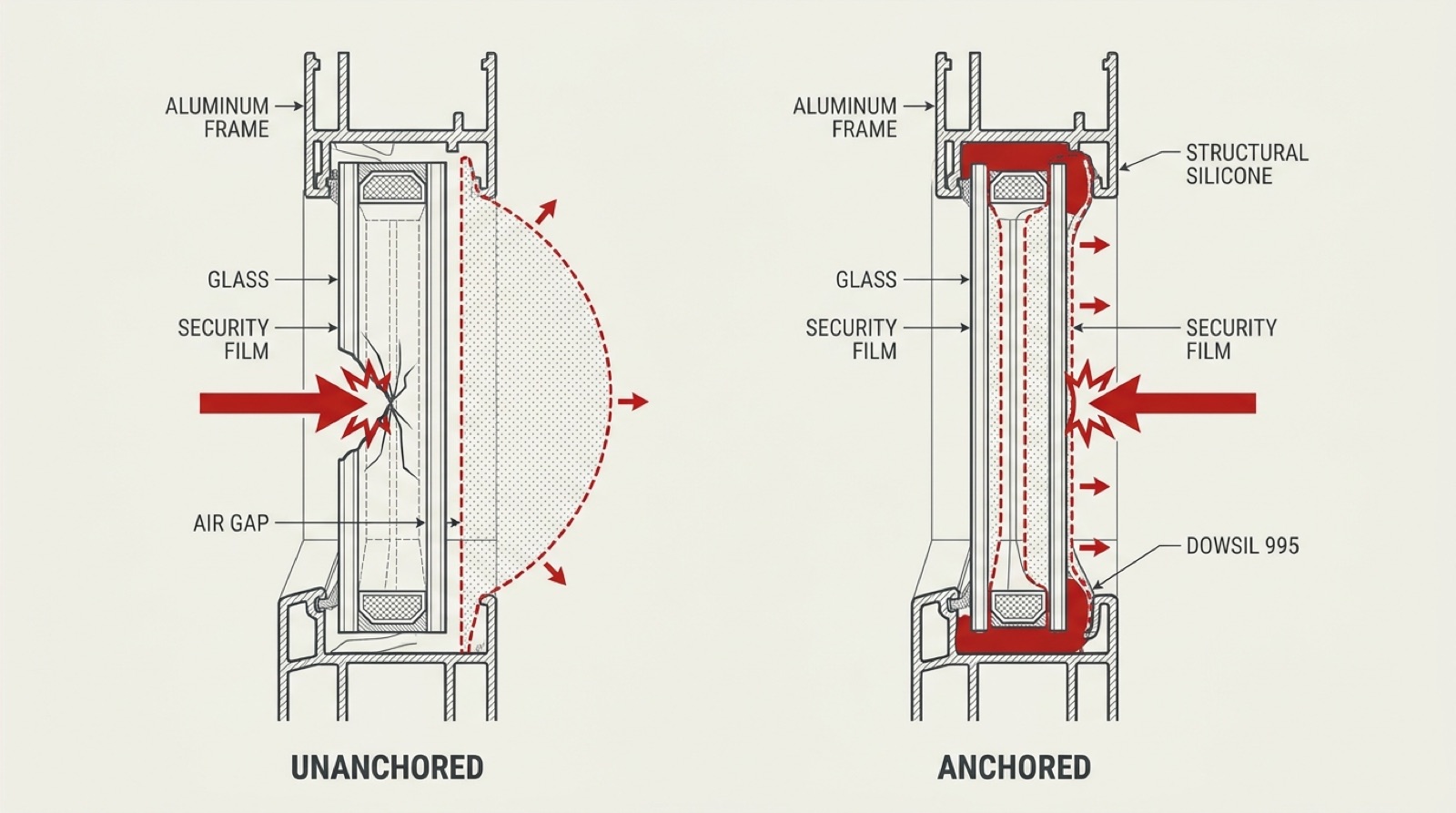
What matters is what happens at the edge. Anchored versus unanchored. It's the most important spec in this category and the one almost no one explains, because unanchored is cheaper, faster, and looks identical on install day.
How long does untreated glass hold against a break-in?
The most common forced-entry tool in the GTA is also the dumbest: a cinder block, a landscaping rock, a spring-loaded window punch, or whatever's heavy and within arm's reach of the driveway. Residential back doors and ground-floor patio windows get hit because they are, engineering-wise, the softest part of the envelope.
The numbers confirm the pattern. Toronto Police logged 6,023 break-and-enters in 2025 - down 12.1% from 2024's 6,850, which is good, but still averages roughly 17 break-ins every day across the city.1 In Peel, Mississauga alone reported 1,784 break-and-enters in 2024, a year-over-year increase of 11.3%.2 In York Region, Vaughan accounted for 30.5% of the region's entire B&E volume - 749 incidents, the highest of any municipality.3
And the clearance rate tells you something the volume doesn't. York Regional Police reported a 20% clearance rate for break-and-enter offenses in 2024.3 Four out of five reported break-ins go unresolved. The deterrent isn't the police report you file afterward - it's the sixty seconds at the window that either hold or don't.
What is security window film, and what isn't it?
Security window film is a multi-layer polyester (PET) sheet coated with pressure-sensitive adhesive, measured in thousandths of an inch - "mils" in the trade. Consumer-grade safety film runs 4 mil. A lot of the product labeled "security" in the Canadian market is 6 or 8 mil. ImpactGuard installs a 14-mil product sourced from manufacturers like Madico and Solar Gard, which is heavier than the 12-mil spec most competitors run and closer to what specifiers call "protective attack-resistant film."
The film is optically clear. Once it's on your glass, you can't see it from outside or inside. It doesn't tint, doesn't haze, doesn't change the color of light passing through. That's the first thing every homeowner asks and the answer is always the same: if we did our job, you won't know the difference visually.
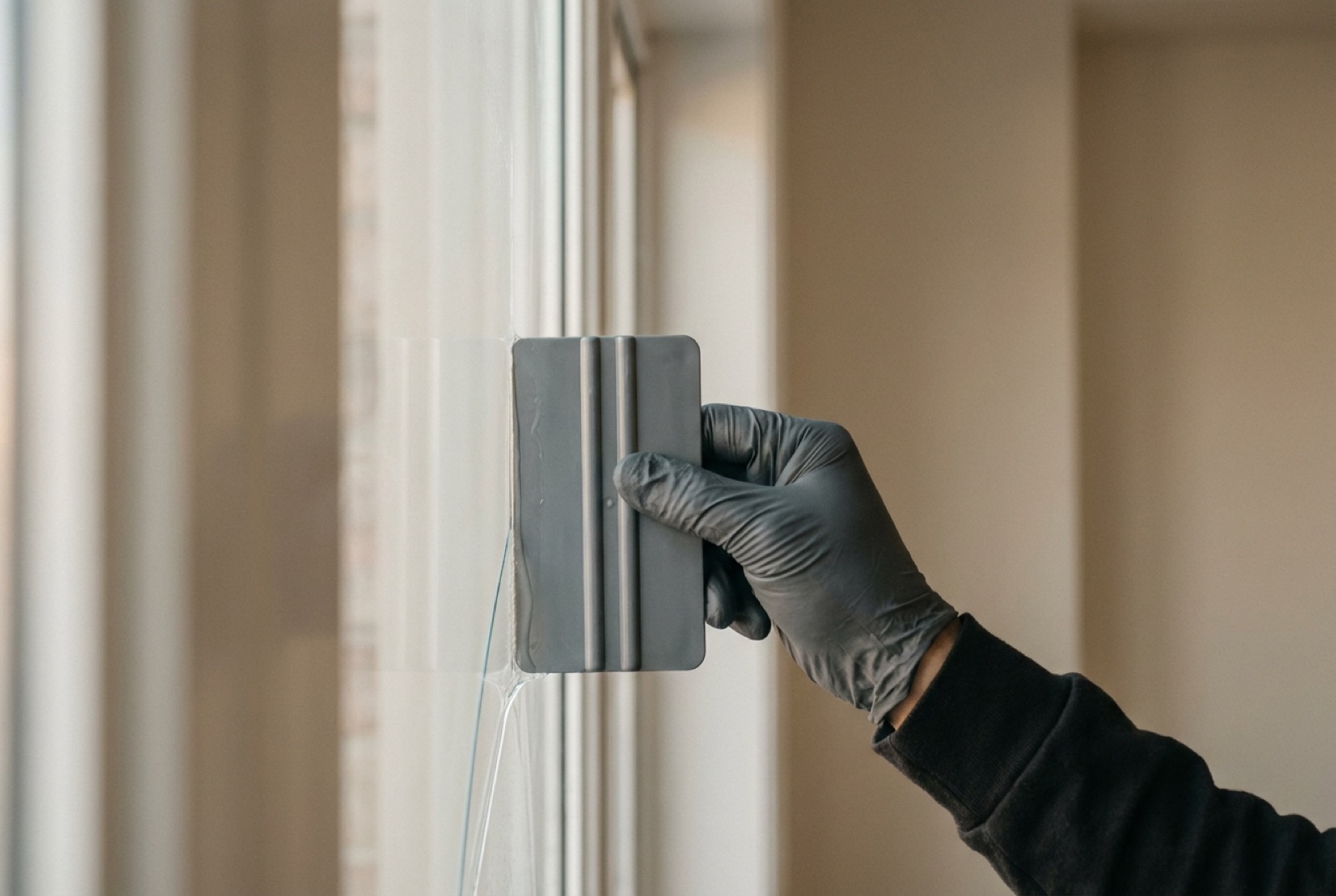
Here's what 14-mil film is not. It is not bulletproof. It is not a guarantee. Its job is to delay forced entry long enough for the would-be intruder to either abandon the attempt or for someone - alarm responder, neighbour, you - to react. UL's own certification language calls it "burglary-resisting," not burglary-proof. That distinction matters, and anyone who tells you otherwise is selling you something.
What does UL-972 actually test for?
UL 972 - Standard for Burglary-Resisting Glazing Material - is the North American benchmark certifying laboratories use to evaluate whether a piece of treated glass can withstand a focused attack long enough to matter. The test is not abstract. It involves dropping a steel ball on the glass from a specified height, then following up with a human attacker wielding a hammer, attempting to defeat the barrier within a set time. Glass assemblies that hold through the drop and the attack phase pass. Glass that doesn't, doesn't.4
The critical word in that sentence is properly installed. UL 972 certifies the glazing material. It does not certify the installer. You can buy a UL-972-certified roll of film, hand it to someone with no training, and they can apply it to your windows in a way that meets none of the performance expectations the certification implies. This is, in fact, the single most common failure mode we see when we inspect jobs done by other companies.
Which brings us to the edge.
Why do most security film installs fail at the edge?
An unanchored install - sometimes called a "daylight" or "edge-to-edge" install - applies security film to the glass only. The installer measures the visible pane, cuts the film a few millimetres short, squeegees it on, and walks away. Clean, fast, invisible.
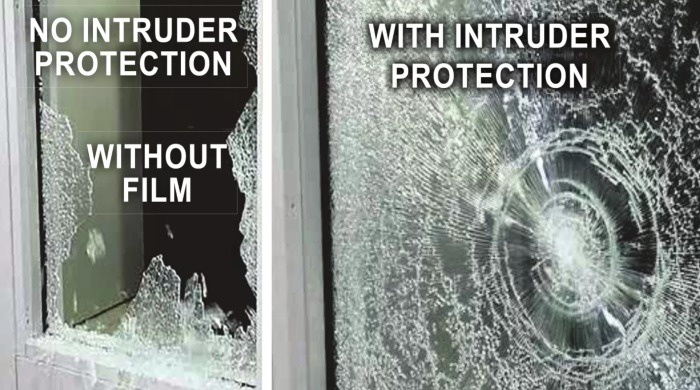
Here's what happens when someone hits that window with a landscaping rock. The glass fractures on impact - the film's job isn't to stop the glass from breaking, it's to hold the shards together as a sheet. So far, so good. But the impact also flexes the entire pane inward. With no bond to the frame, the film flexes with it - and because the edge is sitting on the face of the glass, not anchored to the metal around it, the sheet simply lifts out of the frame. The install failed at the edge because there was no edge.
What makes an anchored security film install different?
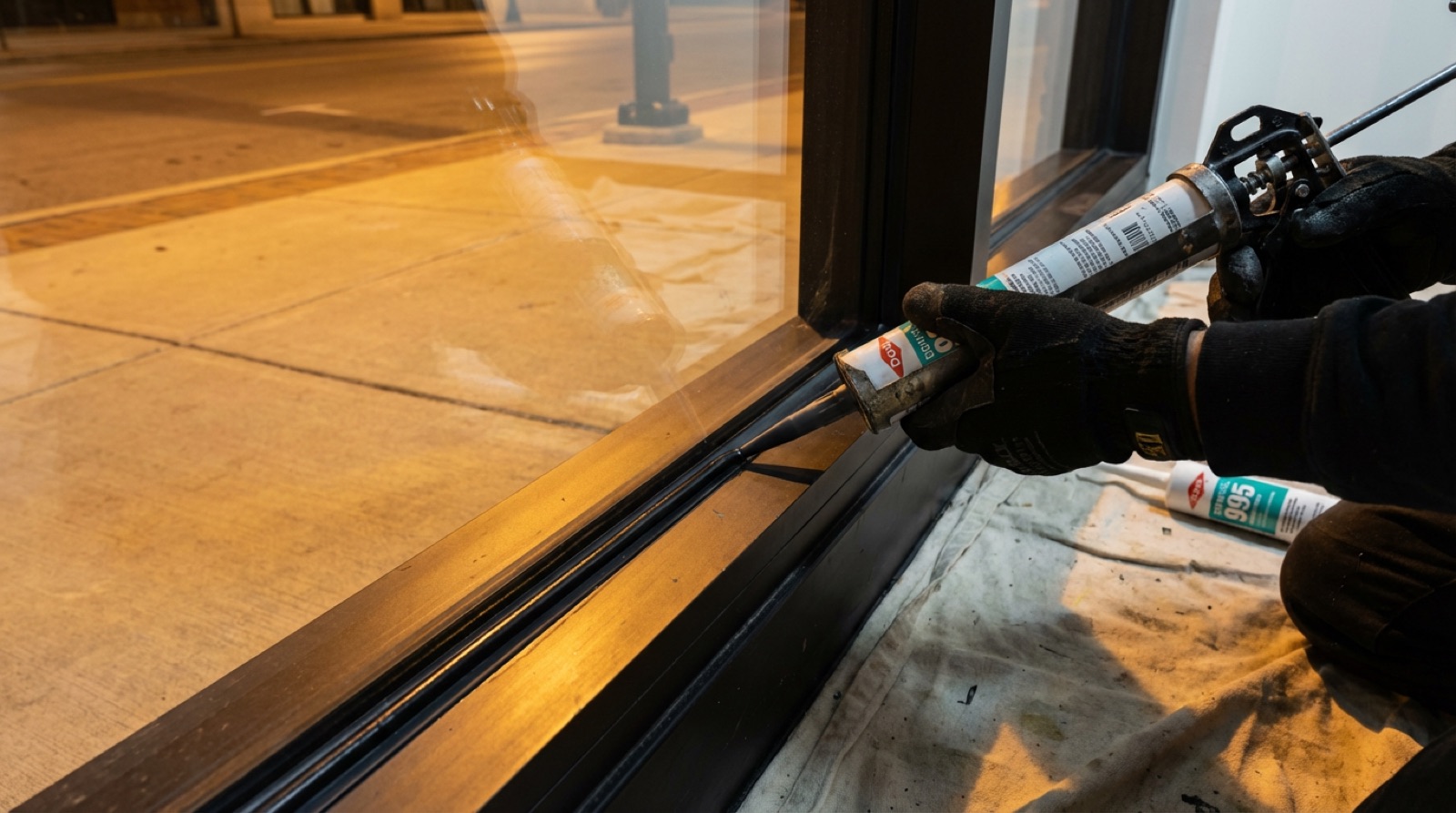
An anchored install adds a second operation that unanchored installs skip entirely. After the film is applied to the glass and fully squeegeed out, the installer runs a continuous bead of structural silicone around the interior perimeter of the frame, bonding the edge of the film to the metal.
ImpactGuard uses DOWSIL™ 995 Silicone Structural Sealant - a one-part, neutral-cure, high-modulus structural glazing adhesive that Dow markets specifically for structural glazing applications. In plain English, 995 is the same family of adhesive used to bond glass curtain walls to the aluminum skeletons of commercial high-rises. It's designed to transfer structural loads from glass into the building frame - the exact problem we're solving at a smaller scale on a residential patio door.5
When an anchored window takes a strike, the film still holds the broken glass as a sheet. The difference is that the film edge is now load-bearing: force doesn't lift the sheet out of the frame, it transfers into the frame, the same way the curtain wall of a high-rise transfers wind load into the skeleton. An attacker who breaks the glass now faces a flexible but framed membrane they have to defeat again, in tension. In the real world, that usually buys roughly 90 loud seconds, which is often enough to kill a quick smash-and-grab. It only shows up when the edge is anchored.
How can I tell if my security film is anchored or unanchored?
If you already have security film on your windows and want to know whether it was anchored, the test takes thirty seconds and does not require any equipment. Walk up to the inside of the window. Look at the perimeter, where the glass meets the frame.
- Continuous silicone bead around the perimeter- dark, matte, slightly rubbery to the touch (don't press on it if cured recently). That's the anchor. You have an anchored install.
- Film stops short of the frame with a visible gap of exposed glass at the edge. No silicone. That's unanchored - decorative at best.
- Film is wrapped over the glass edge but there's still no silicone. Still unanchored. The wrap-over is cosmetic; the bond that matters is to the frame, not the glass edge.
If you can't tell, or the perimeter is obscured by a stop or a glazing bead that makes the edge hard to read, we'll look at it for free. Anchored retrofits on existing unanchored film are possible but the economics rarely make sense - in most cases the right move is a clean reinstall.
How much more does an anchored install cost than an unanchored one?
Anchored installs cost more than unanchored installs. They take longer - a whole-home anchored residential install is generally completed in a single day, but the perimeter-bead pass adds hours over what a daylight-only installer would quote. They use more product per window. And the labor is skilled - running a consistent structural silicone bead at the tolerance required to actually transfer load is not something you pick up on YouTube.
Our residential installs start around $1,200 and scale with the project - number of openings, pane dimensions, frame type, whether every opening needs an anchored perimeter or only the ground-floor and patio-access openings. Our installed rate across the GTA is $18 per square foot of glass plus $3 per linear foot of perimeter for the anchored silicone edge — the perimeter line is exactly what this article is about, and it is priced separately because a small window carries far more edge per square foot than a large one. Every quote is fixed, written, and produced after an in-person assessment. We don't do remote estimates - if we haven't seen the frame, we haven't really quoted the job.
Most commercial clients - jewelers, pharmacies, dispensaries, premium retail - end up anchoring street-facing glass and any glass within arm's reach of a cash area. Second-story windows no one can reach without a ladder can be candidates for unanchored film if budget is tight. That's a risk-tier conversation we have at the assessment, in person, with the frame in front of us.
Your glass is your weakest point. The edge is the whole install.
Alarms and cameras depend on glass holding long enough for someone to respond. Untreated annealed glass doesn't give you that time. Film does, but only if the install does the less visible, more tedious work of bonding the film to the frame so the whole system behaves as a barrier rather than as a decorated pane.
Walk up to your window. Look at the edge. Silicone bead, anchored. No bead, decorative. If you'd like us to look at it with you, we do in-person assessments across the GTA and typically schedule inside 48 hours.